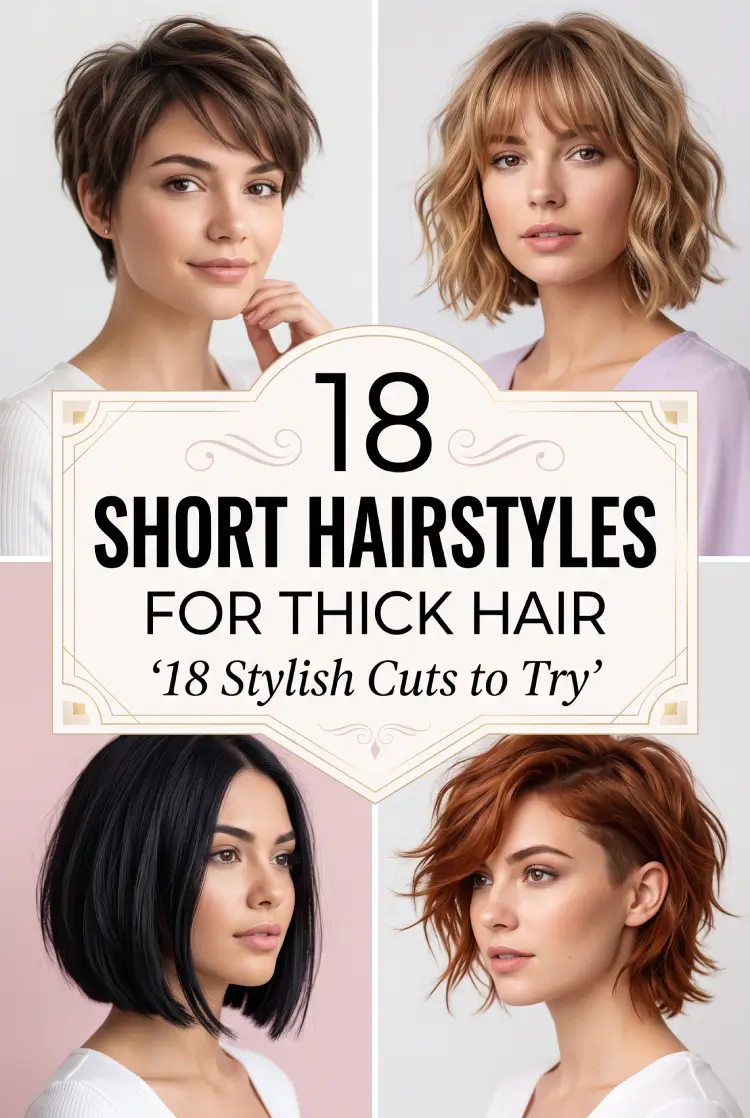
Thick hair gives a short haircut plenty of body, but it can also make the wrong shape feel surprisingly heavy. A bob can puff outward around the sides. A pixie can become bulky at the crown. A blunt cut can feel dense at the nape. And a haircut that looked perfect in the salon can take on a completely different shape after a few weeks of growth.
The answer is not necessarily to remove as much hair as possible. For modern ways to reduce density and bulk, explore our latest guide to short haircuts for thick hair.
For thick hair, a successful short haircut usually comes down to where the weight is removed and where it is deliberately left behind. Internal layers, graduation, tapering and controlled texture can create space inside the haircut while keeping the outer silhouette attractive. Professional haircut guidance for thick hair makes the same distinction: the goal is strategic weight removal that allows the hair to move rather than simply stripping away density.
That makes the choice of haircut especially important.
A layered bob can be a better option than a blunt bob if your hair feels heavy through the ends. A bixie can provide a softer transition if a pixie feels too drastic. A short shag can make thick waves easier to wear naturally, while a tapered cut can concentrate fullness exactly where you want it.
Below are 18 short hairstyles worth considering, followed by practical guidance for choosing the right shape for your hair texture, face shape, lifestyle and maintenance preferences.
Quick Guide: Which Short Haircut Is Best for Thick Hair?
| Haircut | Best Feature | Styling Effort | Maintenance | Tie-Back Potential |
| Layered Bob | Controls bulk while keeping length | Medium | Medium | Sometimes |
| Textured Bob | Adds movement | Low–Medium | Medium | Sometimes |
| French Bob | Compact, polished shape | Medium | Medium | Limited |
| Blunt Bob | Strong perimeter | Medium | Medium | Sometimes |
| Stacked Bob | Controls heavy nape | Medium | High | Limited |
| A-Line Bob | Longer front pieces | Medium | Medium | Sometimes |
| Curved Bob | Soft sculpted outline | Medium | Medium | Medium |
| Bixie | Bob-to-pixie versatility | Low–Medium | Medium | Limited |
| Long Pixie | Major weight reduction | Low | High | No |
| Textured Pixie | Lightweight movement | Low | High | No |
| Curly Pixie | Works with natural curls | Low–Medium | High | No |
| Short Shag | Natural movement | Low–Medium | Medium | Limited |
| Short Wolf Cut | Strong texture | Medium | Medium | Limited |
| Curly Bob | Curl-friendly shape | Low–Medium | Medium | Sometimes |
| Short Curly Crop | Compact natural texture | Low–Medium | Medium | No |
| Tapered Short Cut | Controls sides and nape | Low | Medium–High | No |
| Side-Swept Bangs Cut | Face-framing flexibility | Medium | Medium | Depends on length |
| Short Layered Crop | Lightweight short shape | Low | Medium–High | No |
1. Layered Bob for Thick Hair
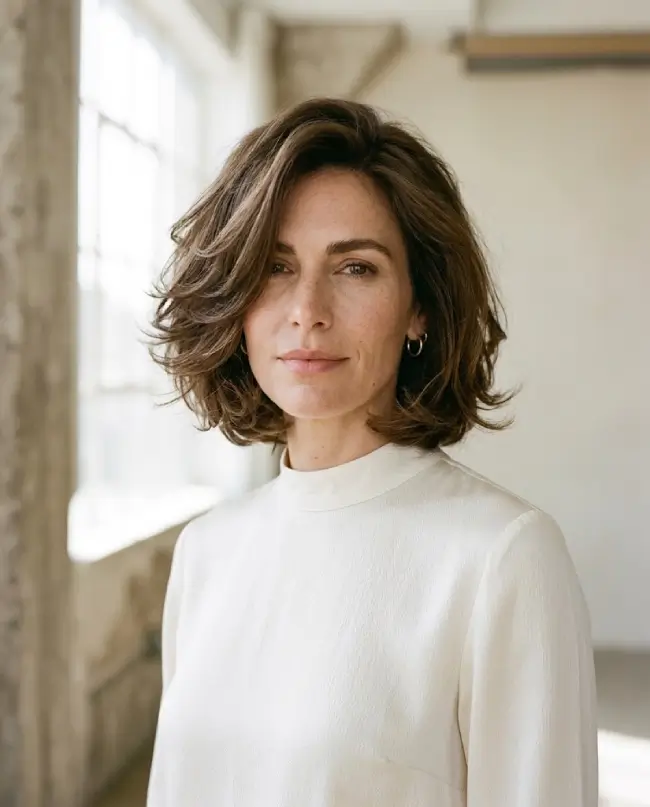
A layered bob is one of the most adaptable choices when thick hair feels heavy but you still want enough length to style it in different ways. Rather than leaving all the density concentrated along one solid perimeter, the haircut uses layers to create movement and redistribute some of the internal weight.
That does not mean the bob needs to look visibly choppy. In fact, internal layers can be hidden beneath the surface, allowing the outside of the haircut to remain smooth and deliberate. This approach can help prevent the overly rounded or “mushroom” shape that dense hair sometimes develops when too much weight remains inside.
Straight thick hair can look sleek and structured in this shape. Wavy hair can make the same bob softer and more relaxed. Curly hair requires more attention to shrinkage and curl placement.
A layered bob is especially useful if you want to keep enough length to tuck your hair behind your ears or occasionally secure it.
Ask your stylist: “I want a short layered bob with internal weight removal, but I want to keep a defined outer perimeter.”
2. Textured Bob That Removes Bulk
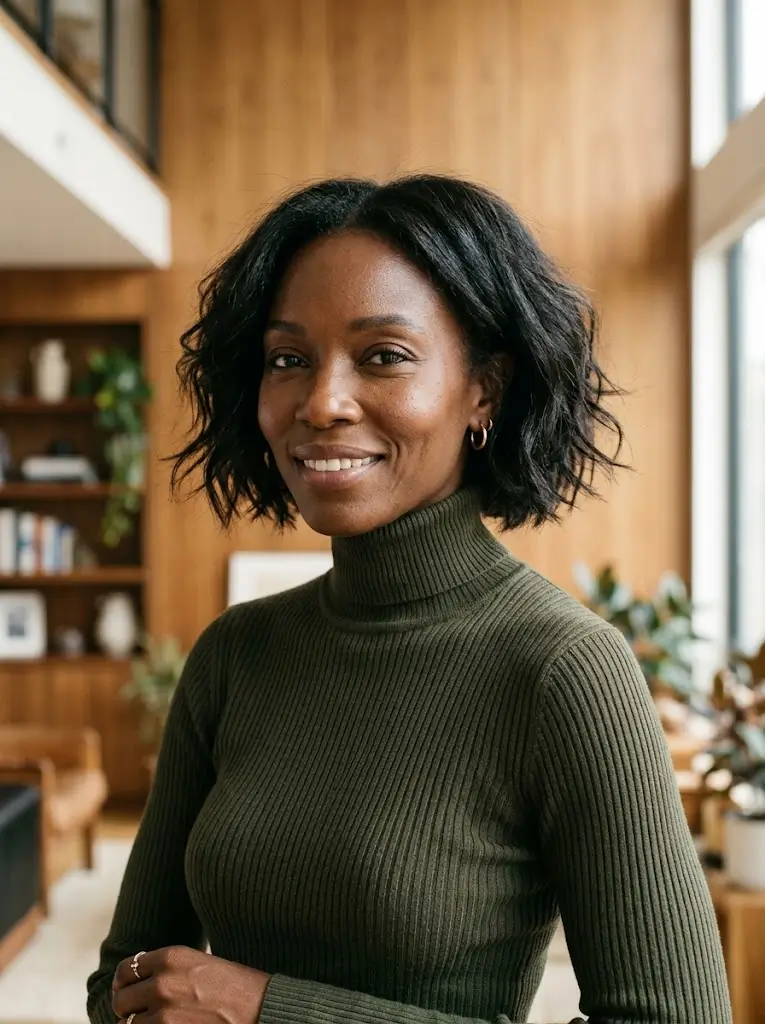
A textured bob gives thick hair a lighter, more mobile appearance without abandoning the recognizable bob silhouette. The texture can be concentrated internally or placed strategically through the ends depending on your hair type.
For thick wavy hair, this is particularly useful because the natural wave can provide much of the movement. You may only need a lightweight mousse or curl cream rather than a full heat-styling routine.
Thick straight hair can also wear the cut beautifully, although the texture may be more visible after a little styling. A few bends through the ends can reveal the separation between layers.
The important distinction is between controlled texture and excessive thinning. Taking too much out of the ends can make thick hair look frizzy or uneven rather than lighter. Internal layering is often a more controlled way to create space.
This is a good choice if your hair feels dense but you dislike the appearance of a heavily layered haircut.
Ask your stylist: “I want movement inside the bob without making the ends look thin or wispy.”
3. French Bob With Soft Face-Framing
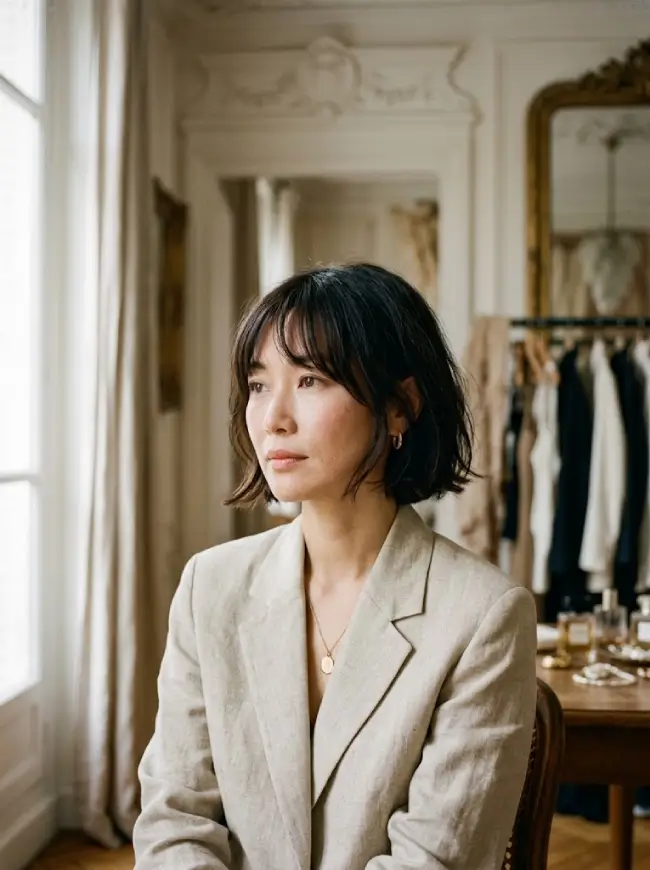
The French bob is usually shorter and more compact than a conventional bob, often sitting around the jawline and paired with some form of fringe or face framing. Thick hair can give this haircut impressive fullness, which is part of its appeal.
The challenge is preventing that fullness from becoming excessive around the sides. Internal weight removal can help the haircut stay compact rather than expanding outward.
Thick straight hair creates a polished, graphic French bob. Thick waves make it softer and more relaxed. Curly hair can also work, but the final length needs to be chosen with shrinkage in mind.
A fringe can completely change the character of the haircut. A full fringe creates a stronger graphic effect, while a softer or side-parted fringe gives more flexibility.
French bobs remain part of the current short-hair landscape alongside curved bobs, bixies and other compact cuts.
Ask your stylist: “I want a jaw-length French bob with soft face framing and enough internal weight removal to keep the sides controlled.”
4. Blunt Bob With a Clean, Full Perimeter
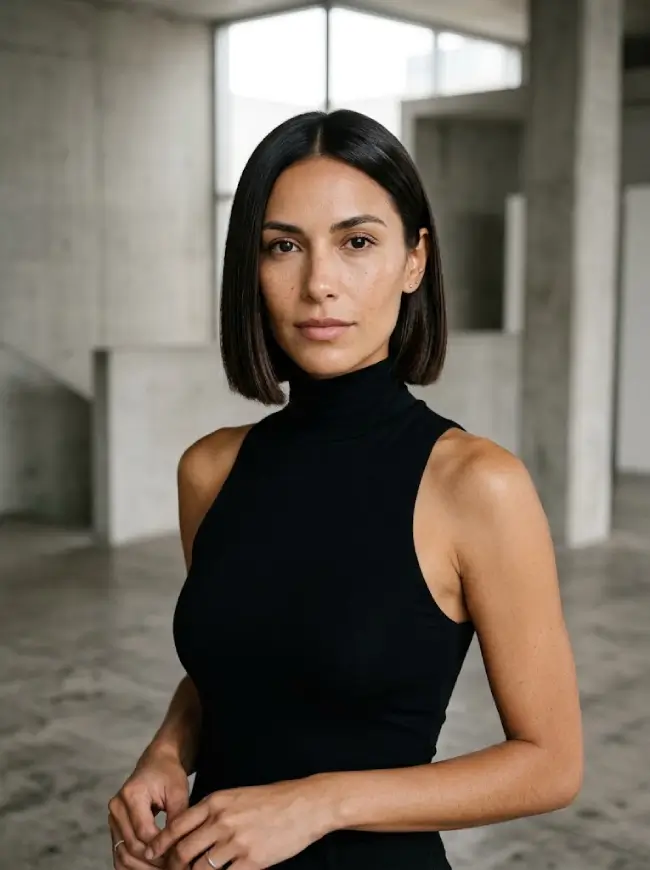
A blunt bob may seem counterintuitive for thick hair, but a strong perimeter can actually be very attractive when the density is managed correctly. The clean bottom line creates structure, while carefully controlled weight inside keeps the haircut from becoming excessively heavy.
This option is particularly appealing if you like polished, minimal styling. Thick straight hair can make the perimeter look substantial and deliberate. Thick wavy hair produces a softer interpretation, while curls may transform the blunt line into a more rounded silhouette.
The biggest consideration is where the ends fall. A bob sitting directly at the widest point of the jaw can emphasize that area, while a slightly shorter or longer version may create a different balance.
If your hair is very dense, the stylist may need to remove some interior weight while leaving the perimeter intact.
Ask your stylist: “I want a strong blunt perimeter, but please reduce the internal bulk so the ends don’t feel too heavy.”
5. Stacked Bob With a Lighter Nape
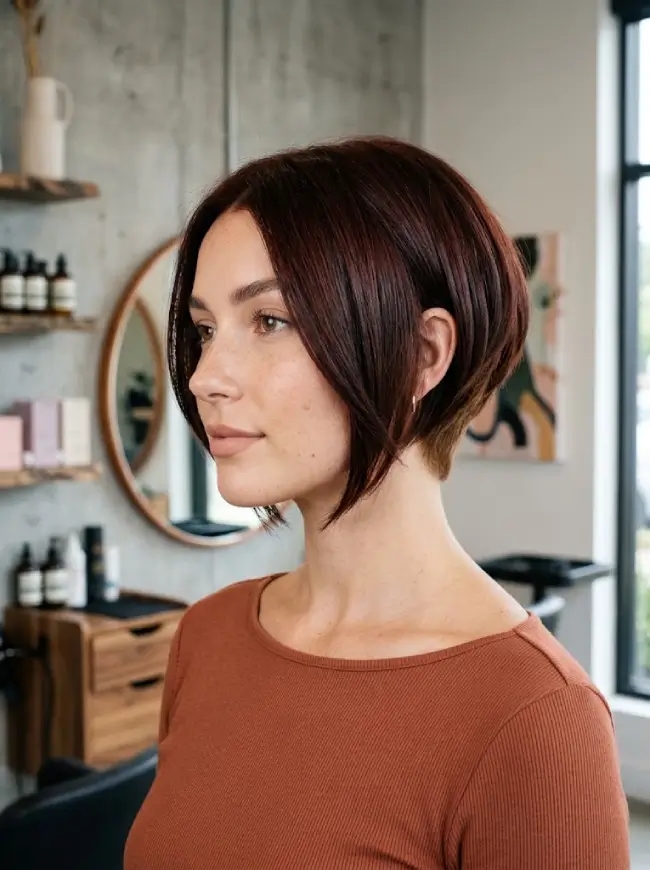
A stacked bob uses graduated sections at the back to create a shorter, more controlled nape with longer pieces toward the front. This makes it especially useful for thick hair that becomes excessively heavy around the back of the neck.
The graduation gives the haircut structure without requiring the entire hairstyle to be short. You can keep length around the face while reducing the dense mass at the nape.
Thick straight hair shows the graduated shape clearly. Wavy hair softens it and creates a more casual finish. Curly hair can also work, but the stylist needs to account for curl shrinkage before deciding the graduation.
This haircut is more maintenance-intensive than a loose shag or textured bob because the stacked shape becomes less precise as it grows.
It also offers limited tie-back ability unless the front and sides are left fairly long.
Ask your stylist: “I want a softly stacked bob that removes weight from my nape but keeps longer pieces around my face.”
6. A-Line Bob With Longer Front Pieces
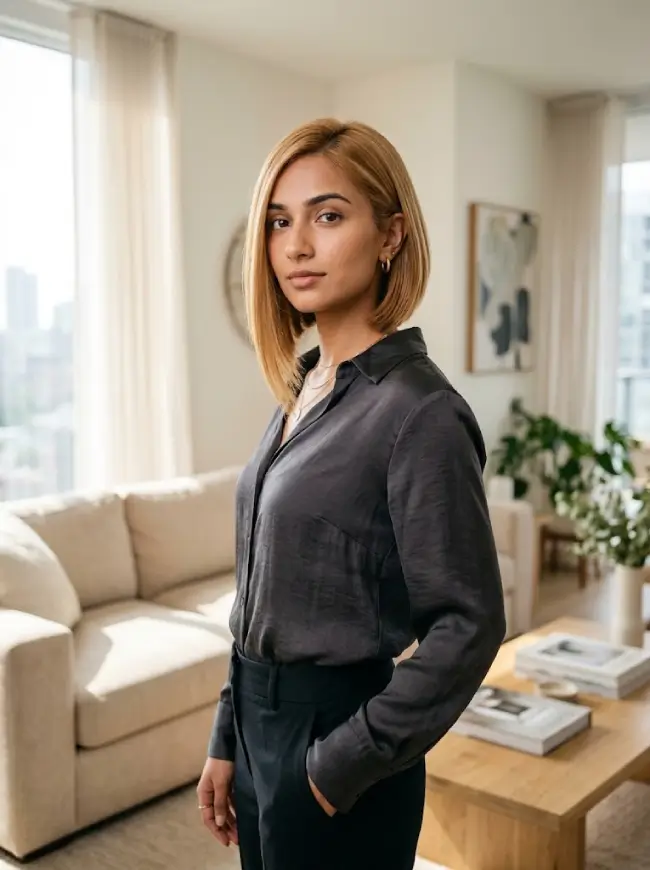
An A-line bob is shorter at the back and gradually becomes longer toward the front. That directional shape can work especially well when thick hair needs control at the nape but you still want length around the face.
The longer front sections create face framing without requiring a heavily layered haircut. This makes the A-line bob a useful compromise between a stacked bob and a conventional bob.
Straight thick hair highlights the clean angle. Wavy hair breaks up the line and makes the style more relaxed.
If you want to secure your hair occasionally, ask for enough length at the front and sides to accommodate clips or small ties.
Face shape can influence the exact angle. An A-line shape is often useful when you want the front pieces to visually lengthen the sides of the face, but the cut should be customized rather than chosen according to a rigid face-shape rule.
Ask your stylist: “I want a short back with longer front pieces that frame my face, while keeping the nape from becoming bulky.”
7. Soft Curved Bob for a Polished Finish
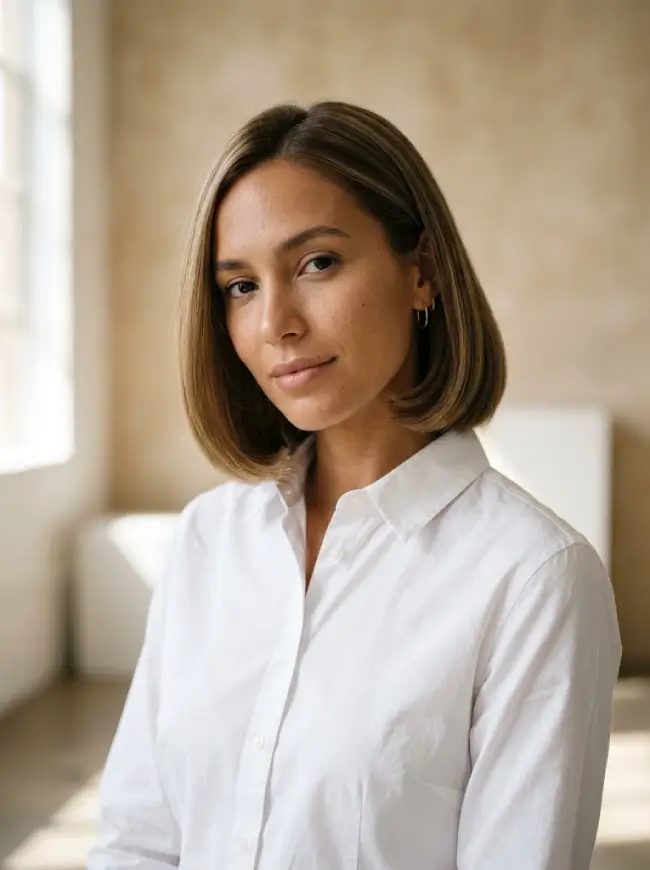
A curved bob has a rounded, fluid outline rather than a sharply angled or completely blunt finish. It can make thick hair look polished without making the haircut feel severe.
The curve can be subtle. You might have ends that gently turn inward, or a perimeter that follows the natural contour of the head and neck.
Thick straight hair is particularly effective for a smooth version of this haircut. Wavy hair can create a softer, less precise variation that still retains the curved outline.
The main consideration is volume placement. If the hair is extremely dense, the stylist may need to reduce internal weight so the curve stays close to the intended shape.
This haircut works well for someone who likes a refined appearance but does not want a heavily layered cut.
Current short-hair coverage also highlights curved bobs as one of the more contemporary alternatives to traditional straight-across bobs.
Ask your stylist: “I want a softly curved bob with controlled internal volume and ends that follow the shape rather than puffing outward.”
8. Bixie: The Bob-Pixie Hybrid
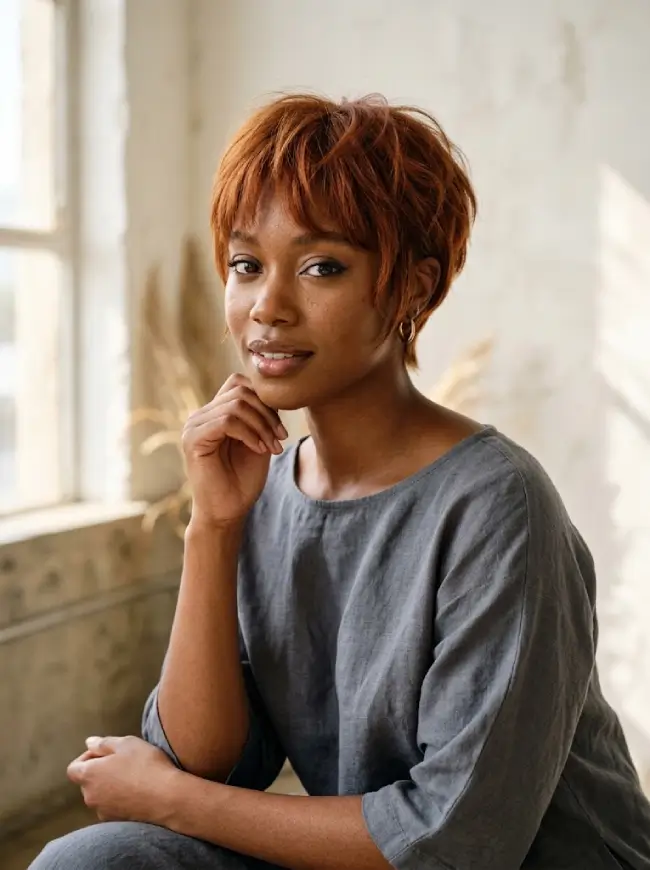
The bixie sits between a bob and a pixie, making it a smart option if you want to lose substantial length without committing immediately to an ultra-short haircut.
For thick hair, the hybrid shape provides plenty of opportunity to redistribute density. The nape and sides can be shortened while the crown and face-framing sections remain longer.
Straight thick hair shows the layering clearly. Wavy hair can make the bixie look naturally tousled, while curly hair can produce a softer, more compact silhouette.
Another advantage is the grow-out. Because the haircut already sits between two lengths, it can transition toward a bob without requiring the same dramatic stages as a very short pixie.
The downside is that a bixie can become bulky if the interior is left too heavy. It needs thoughtful shaping rather than simply cutting a bob shorter.
Ask your stylist: “I want a bixie with internal weight removal, a controlled nape, and enough length around my face to style the front.”
9. Long Pixie With a Textured Crown
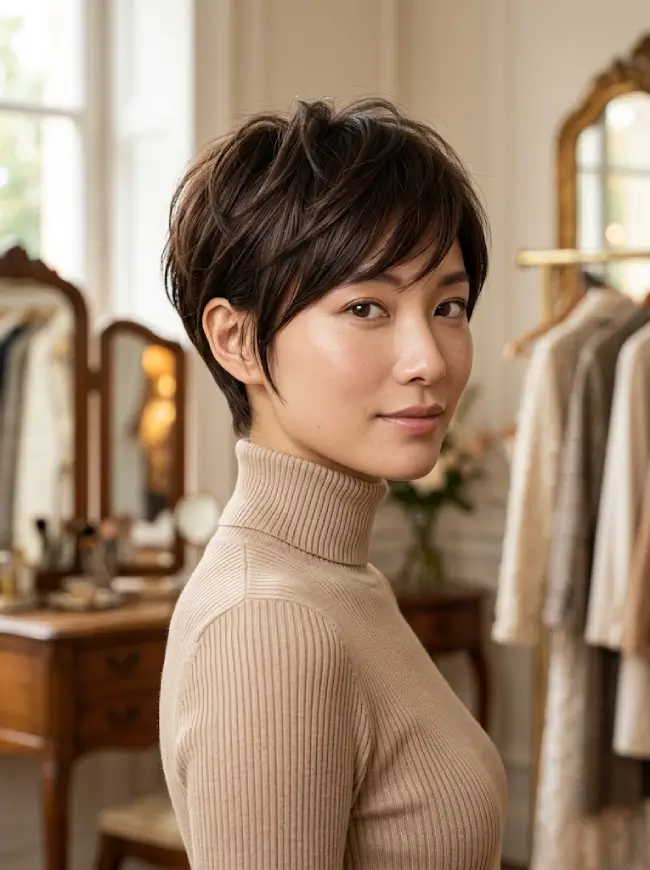
A long pixie is a strong choice when the main objective is to remove a large amount of weight while retaining some styling flexibility.
The sides and nape are generally shorter, while the crown and fringe remain long enough to move. This creates several styling options: swept to one side, pushed forward, separated with texture, or smoothed closer to the head.
Thick straight hair can make the crown look full and structured. Wavy hair adds natural separation. Curly hair can work beautifully, but shrinkage must be considered before deciding the top length.
The main trade-off is maintenance. While there may be less hair to wash and dry, the short outline becomes noticeable quickly as the haircut grows.
A pixie therefore reduces daily styling time but may increase salon frequency. Current professional styling guidance similarly emphasizes that pixies can be quick to style while requiring shape maintenance as they grow.
Ask your stylist: “I want a long textured pixie with a tapered nape and enough crown length to create movement.”
10. Textured Pixie for Maximum Bulk Control
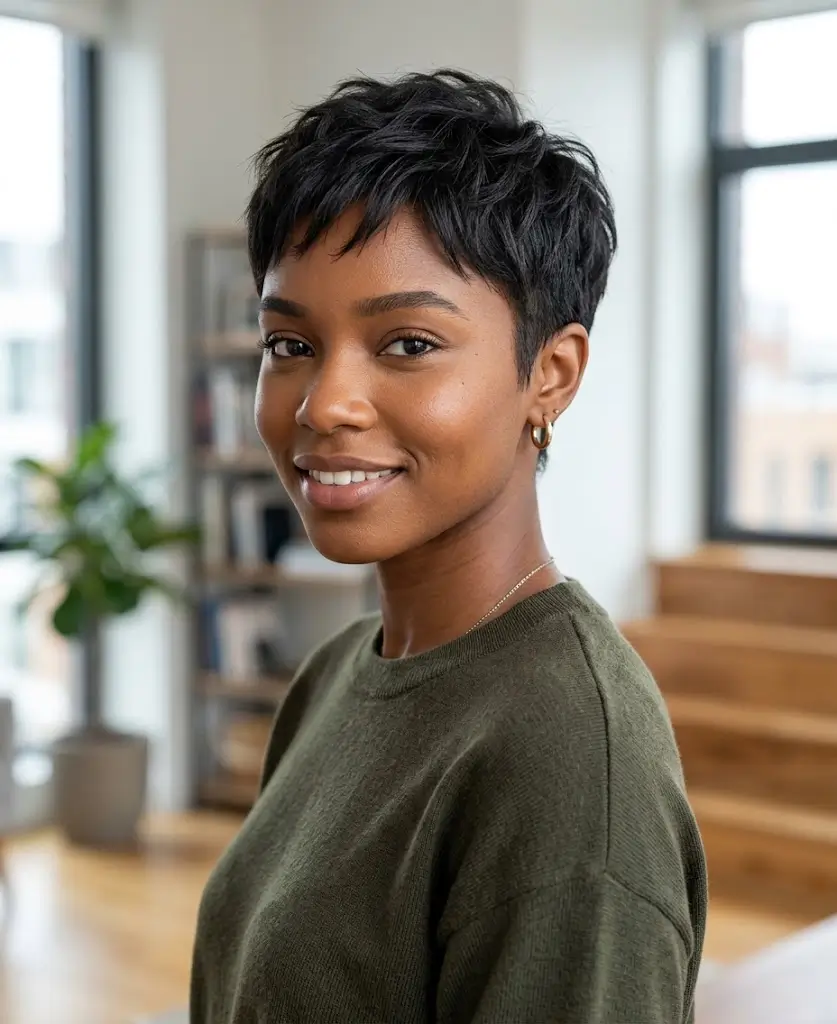
A textured pixie takes the weight-management idea even further. The haircut keeps the sides and nape compact while using texture through the top to prevent thick hair from forming a solid cap.
This is particularly useful if your hair feels bulky even after conventional short cuts. The texture creates separation between sections and makes the haircut easier to manipulate.
Straight thick hair can be styled with a small amount of matte paste or texture cream. Wavy hair may require very little product because the natural movement creates separation automatically.
The mistake to avoid is making every section extremely short. Thick hair often needs some length on top to create movement. If everything is cut too close, density can make the shape appear rigid.
Salon maintenance is relatively high because the short sides and nape lose their shape quickly.
Ask your stylist: “I want a textured pixie that controls the sides and nape but leaves enough length through the crown to prevent a solid, rounded shape.”
11. Curly Pixie Designed Around Natural Texture
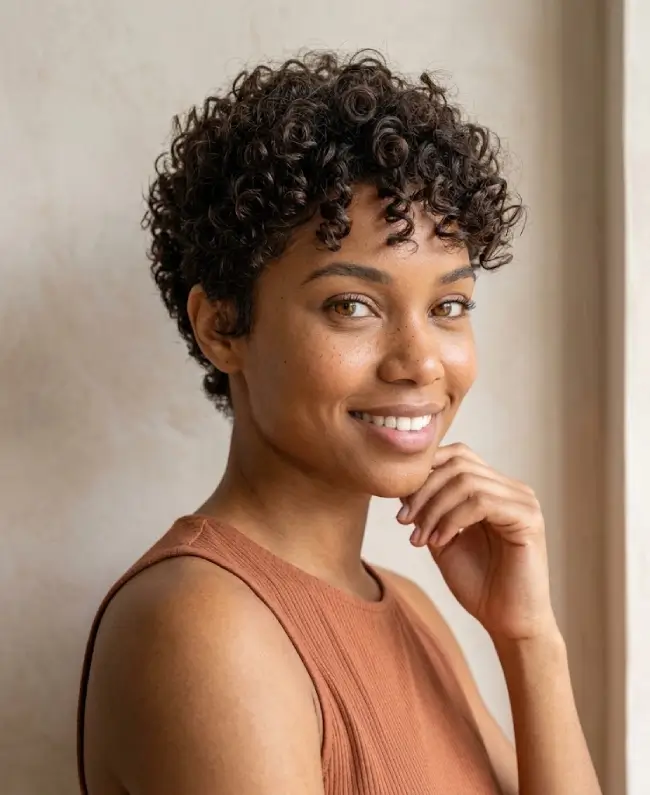
A curly pixie should be designed around the curl pattern rather than treated as a straight pixie with shorter lengths. Thick curls can create significant volume even when the hair is very short, so shrinkage and density need to be considered together.
The sides and nape can be tapered to create definition, while the top retains enough length for the curls to form naturally.
This haircut can dramatically reduce drying time compared with longer thick curls. Daily styling can also be relatively simple: apply curl product to damp hair, shape the curls, and air-dry or diffuse.
The main limitation is the grow-out. Curly hair changes apparent length considerably as it grows, so the shape may shift faster than expected.
If you have a strong curl pattern, bring photographs of your hair naturally styled, not only straightened reference photos.
Ask your stylist: “Please shape the pixie around my natural curl pattern and shrinkage, keeping the sides controlled while preserving enough length on top for my curls to form.”
12. Short Shag With Internal Layers
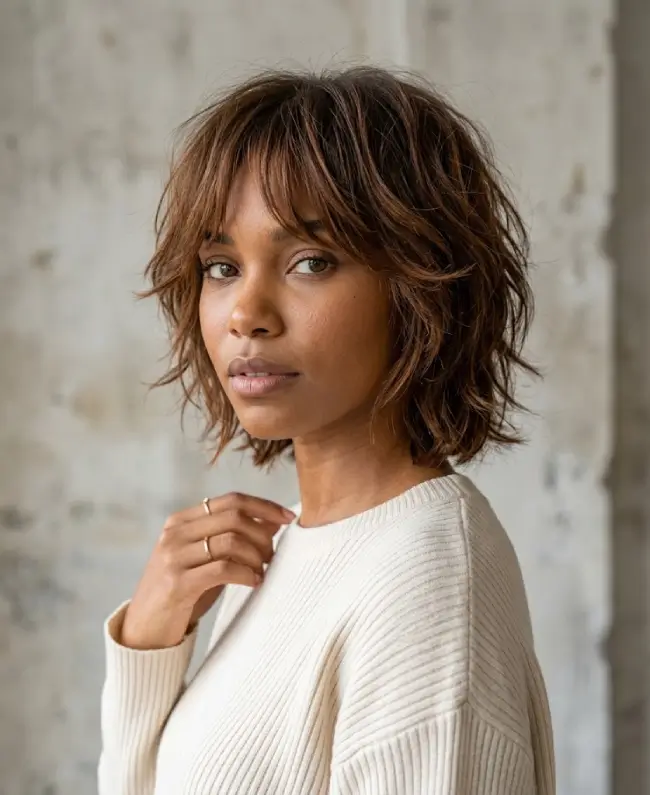
A short shag is one of the strongest choices for thick hair when you want movement rather than a precise geometric outline. The haircut relies on layers, shorter crown sections, face framing and a broken-up perimeter.
Thick wavy hair is especially compatible with this shape because the natural wave helps separate the layers. Air-drying can therefore be practical.
Thick straight hair can also wear a shag, but you may need texture spray, mousse, or a few loose bends to reveal the layering.
The haircut is more forgiving during grow-out than a highly precise bob or pixie because irregularity is already part of the design.
However, a shag is not the best choice if your priority is a smooth, uniform silhouette. The entire point is movement.
Ask your stylist: “I want a short shag with internal layers and face framing that removes weight without making the ends look excessively thin.”
Current haircut coverage also identifies short shags as a useful option for thick hair because layers can redistribute weight while adding movement.
13. Short Wolf Cut With Face-Framing Layers
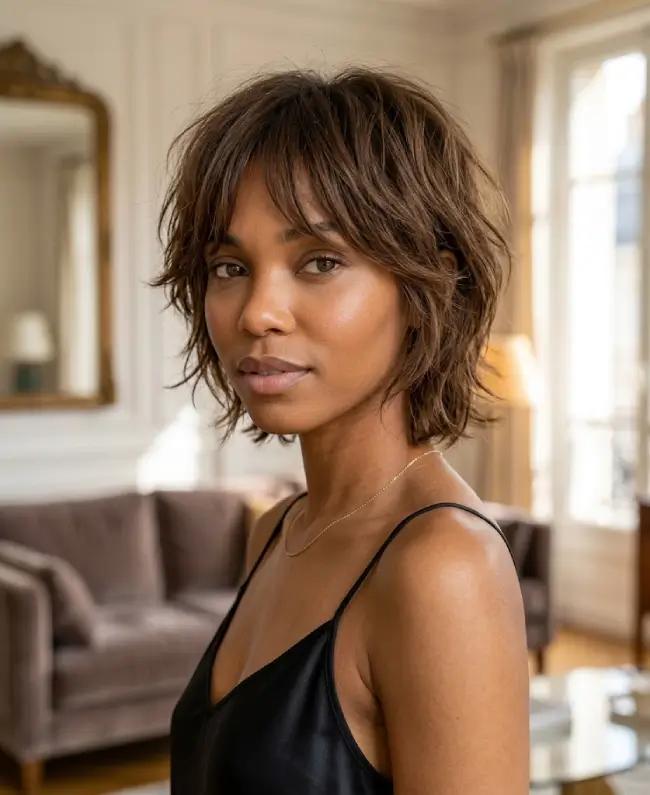
A short wolf cut takes the layered movement of a shag and pushes it toward a more dramatic, heavily textured shape. The crown is usually more layered, while the lower sections retain enough length to create contrast.
Thick hair can support this shape exceptionally well because there is enough density to make the layers visible. The challenge is preventing the haircut from becoming too wide.
Internal weight removal can help the shorter crown sections sit naturally rather than creating a helmet-like effect.
Thick wavy hair is an especially easy match because the natural wave emphasizes the separation between layers. Straight thick hair may need styling to achieve the intended texture.
This haircut suits someone comfortable with a noticeable, deliberately undone finish. It is less appropriate if you need a conservative, highly polished shape every morning.
Ask your stylist: “I want a short wolf-inspired cut with strong crown layers and face framing, but I need the internal bulk controlled so it doesn’t expand too much.”
14. Curly Bob Shaped Around Natural Curls

A curly bob can be one of the most flattering ways to make thick curls feel intentional rather than overwhelming. The important part is designing the perimeter and layers around the curl pattern.
A rounded bob can create a fuller silhouette, while a more graduated shape can reduce weight around the nape.
Curly hair often appears significantly shorter when dry, so the final length needs to be discussed with shrinkage in mind. A chin-length wet haircut may sit much higher once the curls spring back.
Styling can be straightforward once the shape is correct. Apply curl cream or gel to damp hair, encourage the curl pattern, and air-dry or diffuse.
The haircut may require less heat styling than a straight bob, which can make it a practical option for someone who wants to embrace their natural texture.
Ask your stylist: “I want a curly bob shaped around my natural curl pattern, with enough internal space to keep the curls from becoming too bulky.”
15. Short Curly Crop With a Tapered Finish
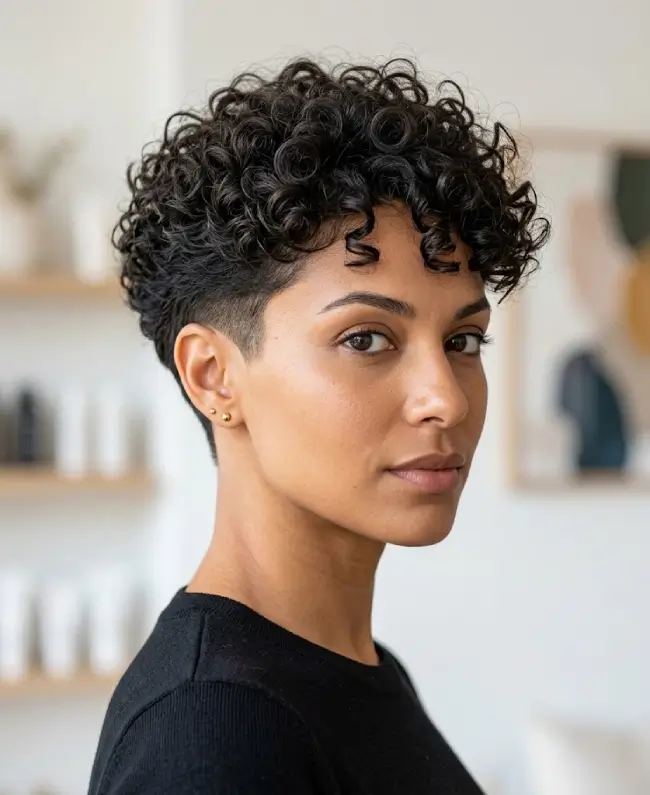
A short curly crop gives thick curls a compact shape while keeping enough length through the top for definition. The sides and nape can be tapered to prevent the entire haircut from becoming equally dense.
This makes it a particularly useful option if your curls are thickest around the sides or back.
The top can remain relatively full, creating contrast between the tapered edges and natural curls. Depending on your curl pattern, this can range from a soft rounded crop to a more defined, sculpted silhouette.
Styling is usually centered around curl definition rather than heat. A leave-in conditioner, curl cream, gel, or mousse may be enough, depending on your hair’s needs.
The grow-out is relatively noticeable around the taper, so regular reshaping may be necessary.
Ask your stylist: “I want a short curly crop with a controlled taper around the sides and nape, while keeping enough length on top for my natural curl pattern.”
16. Tapered Short Cut for Thick Hair
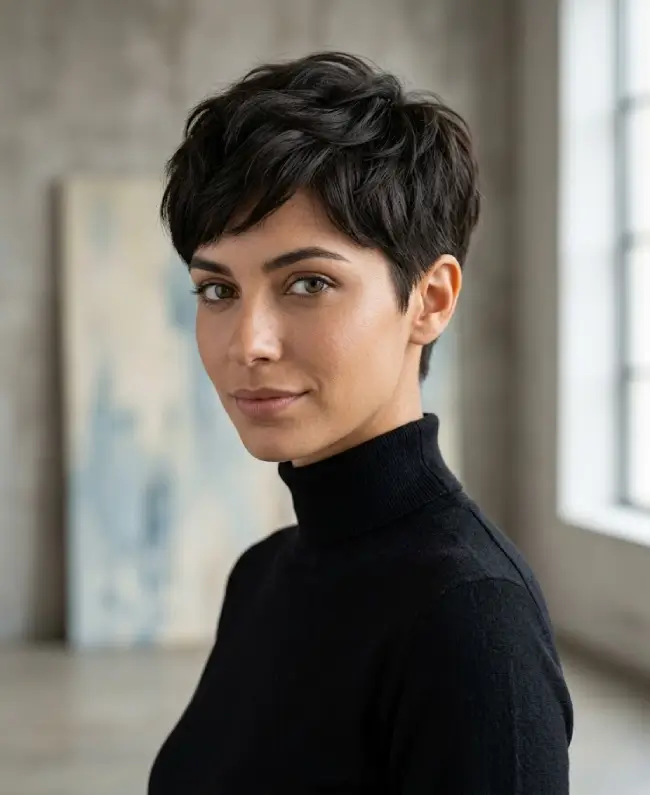
A tapered short cut is particularly useful when your biggest problem is where the hair becomes thick rather than simply how much hair you have. Comparing volume-building techniques across different densities? Check out our guide on short hairstyles for fine hair.
If the sides expand around the ears or the nape becomes heavy, tapering can reduce that concentrated bulk while leaving more fullness on top.
The top can be styled smooth, textured, curly, or naturally wavy. That versatility makes the cut useful across different hair textures.
Straight thick hair gives the taper a clean outline. Curly and coily hair create a stronger contrast between the controlled sides and fuller crown.
The maintenance depends on how close the taper is. A very short taper needs regular cleanup, while a softer taper can grow out more gradually.
Ask your stylist: “My hair is thickest around the sides and nape. I want those areas tapered while keeping the natural fullness through the top.”
17. Short Haircut With Side-Swept Bangs
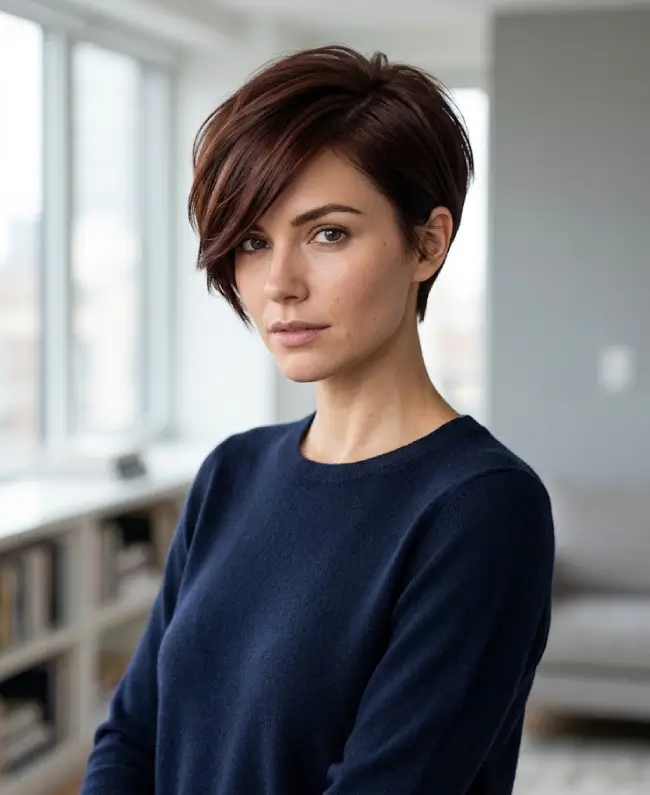
Side-swept bangs can change the appearance of almost any short haircut without requiring a completely different silhouette. They are especially useful if you want face framing but do not want a heavy straight fringe.
Thick hair provides plenty of material for a substantial side-swept fringe. The stylist may need to remove some weight from the bang itself so it bends naturally rather than dropping heavily across the face.
The fringe can be paired with a bob, bixie, pixie, or short layered crop. Its flexibility makes it useful when you are uncertain about committing to a full fringe.
Straight thick hair often requires a quick blow-dry in the desired direction. Wavy hair can create a softer, more casual effect.
The main maintenance issue is growth. Bangs tend to become awkward before the rest of a haircut does, so occasional trims may be necessary.
Ask your stylist: “I want a side-swept fringe that blends naturally into the short haircut rather than looking like a separate block of hair.”
18. Short Layered Crop With Lightweight Movement
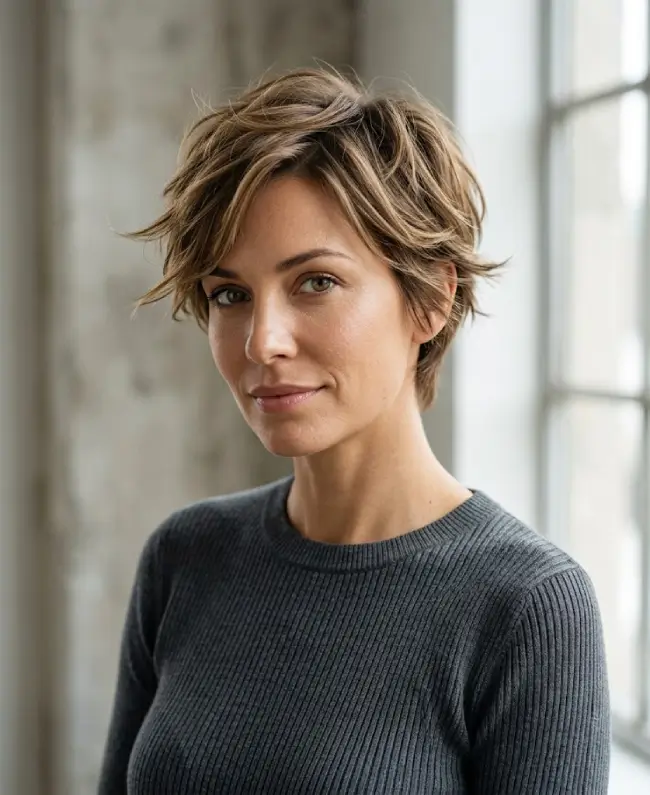
A short layered crop is a practical choice when you want to go noticeably shorter but still want softness through the top. The layers prevent thick hair from sitting as one solid mass.
The crop can be adapted to straight, wavy, curly, and coily textures. The exact layering pattern should change according to how the hair naturally behaves.
For straight hair, texture can create separation. Wavy hair may need almost no styling. Curly and coily textures can retain more length on top so the natural pattern remains visible.
The haircut is relatively quick to wash and dry, but the short perimeter means that regular reshaping may still be necessary.
This is particularly useful for people who are tired of managing long, heavy hair but do not necessarily want a classic pixie.
Ask your stylist: “I want a short layered crop that removes internal weight while keeping enough length on top for natural movement.”
How to Choose the Right Short Hairstyle for Thick Hair
The best haircut depends on more than the amount of hair on your head.
Start by identifying where the bulk bothers you most.
If your entire head feels heavy, a layered bob, shag, bixie or pixie may distribute the density. If the problem is concentrated around the nape, a stacked or tapered shape may be more effective. If your sides expand around the ears, ask specifically about tapering or internal weight removal in those areas.
It is also important to distinguish hair thickness from hair density. Thickness can refer to the diameter of individual strands, while density concerns how much hair is present. These characteristics can overlap, but they are not identical.
Finally, think about what you actually want your haircut to do.
Do you want less drying time? More movement? A haircut you can still clip back? Something that looks good air-dried? Or a polished style you are willing to blow-dry?
Those answers should guide the haircut more than a trend alone.
Short Hairstyles for Thick Hair by Texture
Thick Straight Hair
Straight thick hair shows the architecture of a haircut very clearly. Bobs, A-line cuts, stacked bobs, pixies and tapered shapes can all work because the silhouette remains visible.
The main concern is concentrated weight. A solid short cut can become dense around the nape and sides, so internal layering or graduation may be useful.
If you prefer sleek hair, a smoothing cream and blow-dry can create a polished finish. If you prefer texture, use a lightweight spray or styling cream rather than loading the hair with heavy products.
Thick Wavy Hair
Wavy thick hair has a natural advantage: the wave itself can break up visual bulk.
Short shags, textured bobs, bixies, curved bobs and layered crops can work particularly well.
Try to avoid choosing a haircut solely from a photograph of straight hair. Your wave pattern can change the final length, width and shape considerably.
A mousse or lightweight curl cream can encourage the wave without making the hair feel coated.
Thick Curly Hair
Curly thick hair should be cut with the curl pattern in mind.
Shrinkage means the dry length may be substantially shorter than the wet length, and the curls can also create more width than expected.
Curly bobs, curly pixies, crops and tapered cuts can all work. The most important factor is creating a shape that follows the natural curl pattern instead of forcing it into a straight-hair silhouette.
Thick Coily Hair
Coily hair can look especially striking in short tapered and cropped shapes.
A tapered neckline or sides can control concentrated density while allowing the crown to retain its natural fullness. Rounded crops and sculpted shapes can also showcase the texture.
The cut should be designed around shrinkage, coil pattern and density distribution. A style that looks balanced on stretched hair may look completely different once the coils return to their natural pattern.
Short Hairstyles for Thick Hair by Face Shape
Round Face
Round faces can work with bobs, pixies, bixies and shags. Instead of following a strict rule about what you “cannot” wear, consider where the haircut places width and height.
A longer bob can create a vertical line, while a textured pixie can introduce height through the crown.
With thick hair, controlling excessive side bulk can be helpful if you want a more elongated appearance. Side-swept fringe can also introduce an angled line.
Current stylist guidance similarly treats face shape as one factor among several, alongside texture, lifestyle and personal preference.
Oval Face
An oval face offers considerable flexibility. You can choose the haircut primarily around your texture and lifestyle.
French bobs, layered bobs, pixies, shags and curly crops can all be adapted.
If you have thick hair, focus less on finding a supposedly “perfect” cut and more on deciding how much internal weight you want removed.
Square Face
A square face can look excellent with a strong bob or structured pixie. If you prefer softer lines, waves, side-swept bangs or rounded layers can reduce the visual sharpness of the outline.
Thick hair naturally provides plenty of body, so the stylist can control where that fullness sits.
A blunt bob can intentionally emphasize the jawline, while a textured bob creates a softer interpretation.
Heart-Shaped Face
A heart-shaped face often pairs well with chin-length bobs, longer pixies and side-swept fringe.
The goal is not to hide the forehead or chin but to create a balanced transition between them.
Thick hair gives you enough density to create substantial face-framing sections without needing excessive extensions or styling.
Long Face
For a longer face, consider how much vertical height the haircut creates.
A fringe, chin-length bob or side volume can introduce a different proportion. Excessive height at the crown may elongate the silhouette further.
Thick hair often provides natural width, so you may not need to manufacture additional volume.
Diamond Face
Diamond-shaped faces can work especially well with textured pixies, French bobs and side-swept fringe.
Because the cheekbones are often the widest point, controlling bulk around that exact area can change the overall balance.
Face-framing pieces can be adjusted above or below the cheekbone depending on the effect you prefer.
Which Short Haircuts Remove the Most Bulk From Thick Hair?
If bulk reduction is your number-one priority, the most effective choices are generally the cuts that either shorten the hair substantially or create significant internal space.
Highest bulk reduction
- Tapered pixie
- Textured pixie
- Curly pixie
- Short layered crop
Strong bulk reduction with more styling length
- Long pixie
- Bixie
- Short shag
- Short wolf cut
Bulk control while retaining a bob silhouette
- Layered bob
- Textured bob
- Stacked bob
- A-line bob
The important distinction is that shorter does not automatically mean lighter. A poorly constructed short cut can still feel heavy if too much density remains inside.
Should You Thin Thick Hair Before Cutting It Short?
Not automatically.
Thinning is one possible technique, but it should not be treated as the universal solution to thick hair.
Internal layers can remove weight while keeping the outer shape intact. Graduation can redistribute density. Tapering can reduce bulk around the nape and sides.
The appropriate technique depends on the texture and the desired result.
This is particularly important for curly hair. Removing too much density without considering the curl pattern can change how the curls group together.
If you want a lighter haircut, describe where the hair feels heavy instead of simply saying, “Thin my hair.”
For example:
“The sides feel too bulky, but I want to keep fullness through the crown.”
That gives the stylist a much more useful starting point.
Best Low-Maintenance Short Hairstyles for Thick Hair
Low maintenance needs a little clarification.
A haircut can be quick to style but require frequent salon visits. Pixies are the clearest example. They may take very little time to wash and dry, but the short outline needs regular reshaping.
For quick daily styling, consider:
- Textured pixie
- Tapered short cut
- Short layered crop
- Natural-texture bixie
For easy air-drying, consider:
- Short shag
- Wavy textured bob
- Curly crop
- Curly bob
For a more forgiving grow-out, consider:
- Layered bob
- Textured bob
- Short shag
- Soft curved bob
The easiest option is the one that works with your natural texture rather than requiring you to recreate a completely different texture every morning.
Short Hairstyles for Thick Hair You Can Tie Back
If tying your hair back matters, do not wait until after the haircut to mention it.
A pixie generally cannot form a conventional ponytail. A bixie may allow clips, tiny elastics or partial tie-backs, but it is not the same as a full ponytail.
A chin-length bob may allow some hair to be secured, particularly if your hair is straight. A neck-length bob gives you considerably more flexibility.
Thick curly hair may require additional length because shrinkage reduces the amount available to gather.
If you exercise regularly, work in a setting where hair must be secured, or simply like having the option of putting your hair up, say:
“I want to remove as much weight as possible, but I still need enough length to secure my hair.”
That can dramatically change which short haircut is appropriate.
Bob vs. Pixie for Thick Hair
| Factor | Bob | Pixie |
| Length | More | Much less |
| Bulk reduction | High | Very high |
| Styling versatility | High | Moderate |
| Ponytail potential | Sometimes | Usually no |
| Drying time | Moderate | Short |
| Salon maintenance | Moderate | High |
| Grow-out | Easier | More noticeable |
| Commitment | Moderate | High |
| Natural texture | Very adaptable | Very adaptable |
Choose a bob if:
You want shorter hair but still want versatility, face-framing options and some possibility of tying it back.
Choose a pixie if:
Your biggest priorities are removing length, reducing drying time and creating a genuinely short haircut.
Choose a bixie if:
You are caught between the two and want a transition point rather than an immediate commitment.
How to Style Short Thick Hair
For Straight Thick Hair
Use a smoothing cream before blow-drying and direct the hair according to the haircut’s shape.
Avoid piling on heavy oils or creams if your hair already feels weighed down.
For Wavy Thick Hair
Apply mousse or lightweight curl cream to damp hair, scrunch gently and air-dry or diffuse. Layers are a game-changer for thick tresses—discover why in our guide to bob layer cut hairstyles.
The haircut should create enough movement that you do not need to manually style every section.
For Curly Thick Hair
Prioritize curl definition. Apply product evenly while the hair is damp, shape the curls and allow them to dry without excessive manipulation.
For Coily Thick Hair
Focus on moisture, definition and shape retention. A tapered or cropped haircut can make styling more manageable by reducing the amount of hair that needs to be manipulated.
What to Tell Your Hairstylist
A reference photo is useful, but your stylist also needs to understand what you want the haircut to solve.
For a layered bob:
“I want a short bob that keeps its outer shape but removes some of the internal weight because my hair is very dense.”
For a textured bob:
“I want movement inside the haircut without making the perimeter look thin.”
For a pixie:
“I want the sides and nape controlled, but enough length through the crown to keep the haircut soft and movable.”
For a shag:
“I want visible layers and movement, but I don’t want excessive thinning through the ends.”
For curly hair:
“Please design the haircut around my natural curl pattern and account for shrinkage when choosing the length.”
For a taper:
“The sides and nape are where my hair becomes too bulky. I want those areas controlled while keeping fullness on top.”
Useful terminology includes perimeter for the outer edge of the haircut, internal layers for hidden weight-removing sections, graduation for progressively changing lengths, tapering for gradually shortening an area, and face framing for pieces shaped around the face.
Frequently Asked Questions
What is the best short haircut for thick hair?
Layered bobs, textured bobs, bixies, pixies, shags and tapered cuts are all strong choices. The best one depends on where your hair feels heavy, your natural texture, and how much maintenance you want.
Should thick hair be layered?
Often, strategic layering can help redistribute weight and create movement. It does not necessarily mean adding many visible layers. Internal layers may provide bulk control while keeping the exterior clean.
Is a blunt bob good for thick hair?
Yes. A blunt bob can look excellent on thick hair because the density supports a strong perimeter. The interior may need to be controlled if the hair becomes too heavy.
Is a pixie good for thick hair?
Yes. Thick hair can give a pixie excellent body and texture. Internal shaping and tapering are important so the cut does not become overly bulky.
What short haircut removes the most bulk?
A tapered pixie, textured pixie, curly pixie or short layered crop can remove a substantial amount of weight. A bixie or layered bob provides a less dramatic alternative.
How do I stop short thick hair from looking puffy?
Start with the haircut. Ask about internal weight removal, graduation or tapering rather than simply requesting heavy thinning. Styling should then work with your natural texture.
Is thinning thick hair a good idea?
Sometimes, but it depends on the hair and haircut. Thinning is not automatically better than internal layering or graduation. Discuss the desired result rather than requesting a specific tool.
What is the best short haircut for thick wavy hair?
A textured bob, short shag, bixie or wolf-inspired cut can work particularly well because the natural wave contributes movement.
What is the best short haircut for thick curly hair?
A curly bob, curly pixie, tapered crop or short curly crop can all work. The haircut should be customized around the curl pattern and shrinkage.
Can thick hair be cut into a French bob?
Absolutely. Thick hair can give the French bob beautiful fullness. Internal weight control can help prevent excessive width around the sides.
What is the easiest short haircut for thick hair?
A textured pixie or tapered crop can be very quick to wash and style. If you want more length and versatility, a soft shag or textured bob may be easier overall.
Can short thick hair be tied back?
It depends on the length. A pixie usually cannot form a ponytail, while a chin-length or longer bob may allow at least a partial tie-back.
How often should short thick hair be trimmed?
Precise pixies and stacked cuts usually need reshaping more often than softer bobs and shags. The right interval depends on how quickly your haircut loses its intended outline.
Is thick hair the same as coarse hair?
No. Hair thickness can refer to the diameter of an individual strand, while density refers to how much hair is present. A person can have fine strands with high density or coarse strands with lower density.
Which is easier to grow out, a bob or pixie?
A bob is generally easier because it already provides more length and has more intermediate shapes available. A pixie usually passes through several distinct stages before reaching bob length.