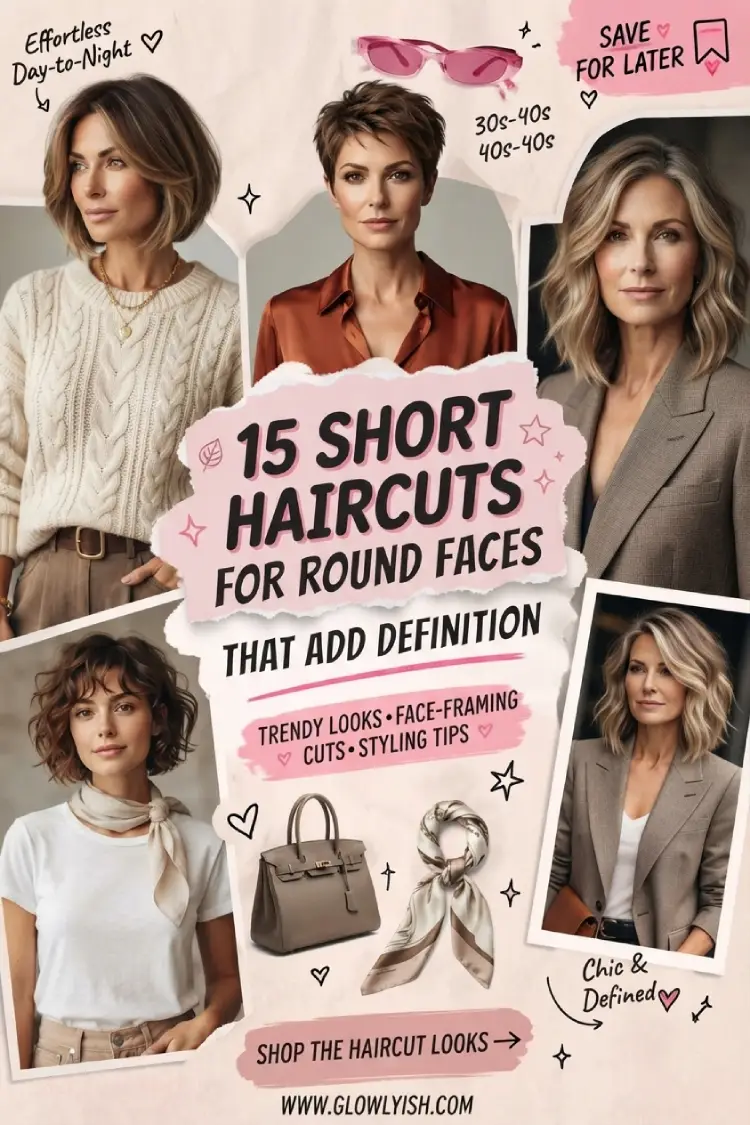
A round face can look incredibly striking with short hair. The trick is not to hide the natural softness of the face, but to choose a haircut that creates balance through For related styling inspiration, explore how to choose the right hairstyle.height, angles, texture, and thoughtful length placement.
The most flattering short haircuts for round faces often keep some lift through the crown, reduce unnecessary width around the cheeks, or introduce diagonal lines with a side part, side-swept fringe, or longer front pieces. That does not mean every round face needs the same haircut. Hair texture, density, styling habits, and the amount of maintenance you are willing to handle all matter.
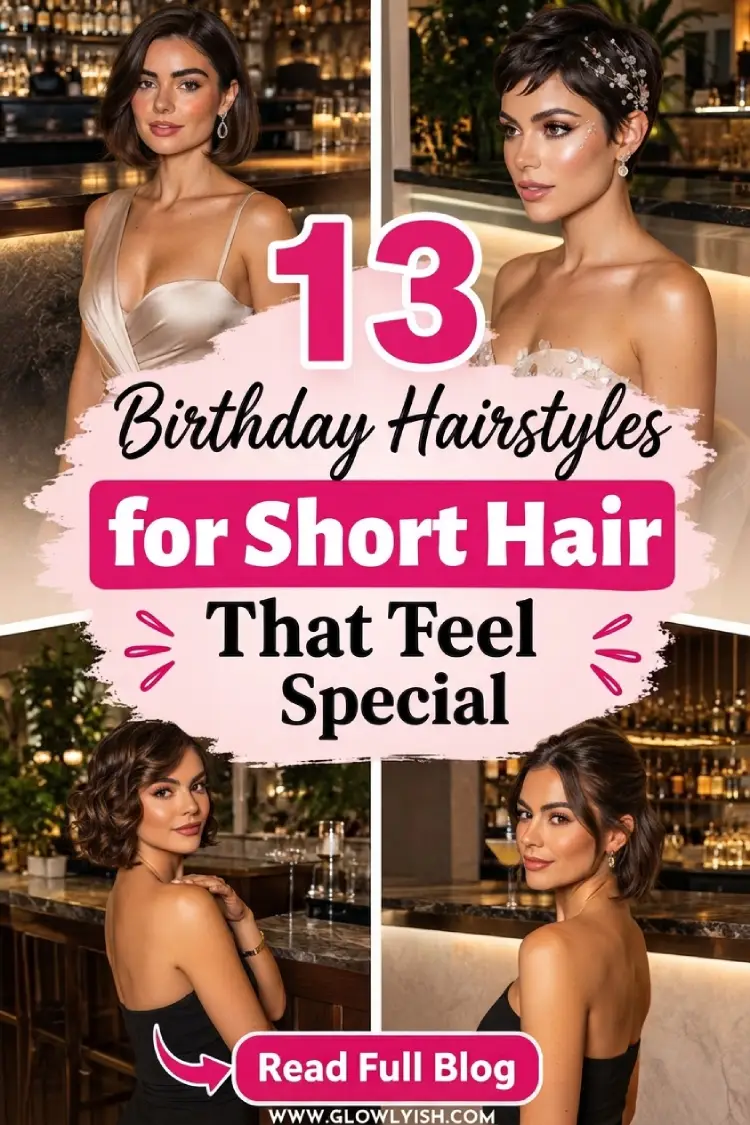
From textured pixies and bixies to angled bobs and short shags, these 15 cuts offer different ways to create definition while keeping the look modern and wearable.
Quick Picks: Which Short Cut Is Right for You?
| If you want… | Consider… | |
| Maximum lift | Textured pixie | |
| More length | Angled bob | |
| A pixie without going ultra-short | Bixie | |
| Easy styling | Layered bob | |
| A bold look | Asymmetrical pixie | |
| Softness around the face | French bob with side fringe | |
| Natural texture | Short shag | |
| Fine-hair volume | Graduated bob | |
| Thick-hair weight removal | Tapered textured crop | |
| A softer fringe | Curtain-bang bob |
The general principle is simple: height and diagonal movement can visually elongate the face, while excessive volume at cheek level can add unwanted width. Current stylist and beauty-editorial guidance repeatedly points toward these proportions rather than treating “short hair” as a single category.
1. Textured Pixie with Crown Volume
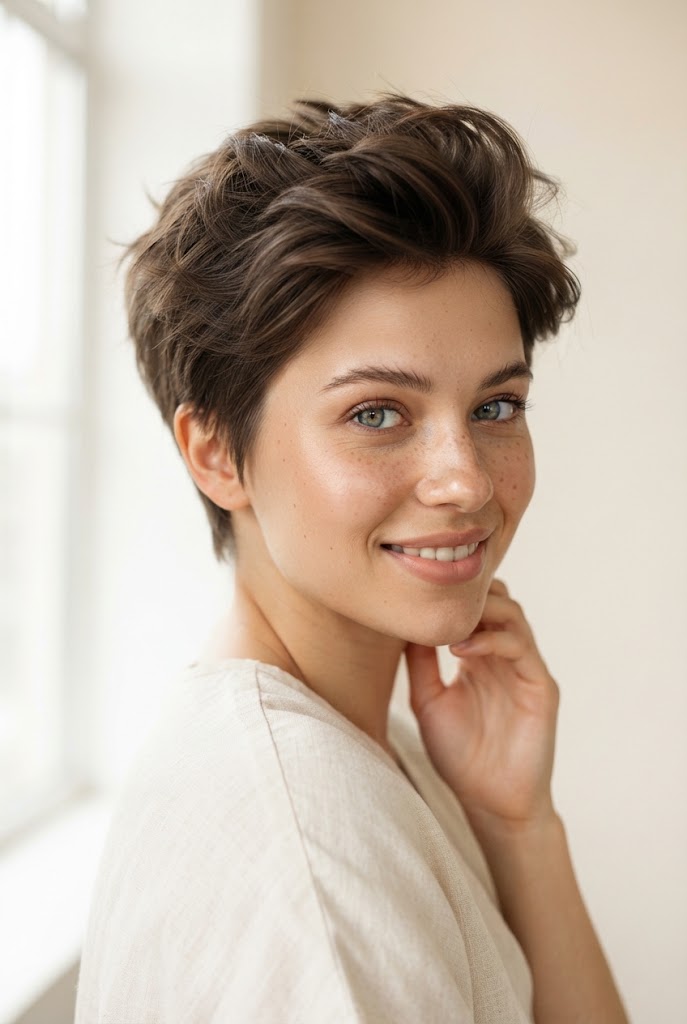
A textured pixie is one of the strongest choices if your main goal is to create definition with very short hair. The important detail is the distribution of volume: keeping the sides relatively neat while allowing the crown and top to carry texture creates a more vertical silhouette. Instead of forming a rounded shape around the head, the haircut directs attention upward.
This version works particularly well for fine-to-medium hair because choppy layers can make the hair appear fuller without requiring excessive product. Thick hair can also wear it beautifully when the stylist removes weight internally.
For styling, use a lightweight mousse or texture cream and lift the roots while drying. Ask your stylist for shorter tapered sides, a slightly longer textured crown, and enough length on top to create height. This cut requires regular trims, but daily styling can be surprisingly quick.
Best for: Fine, medium, straight, or wavy hair.
2. Angled Bob with Longer Front Pieces
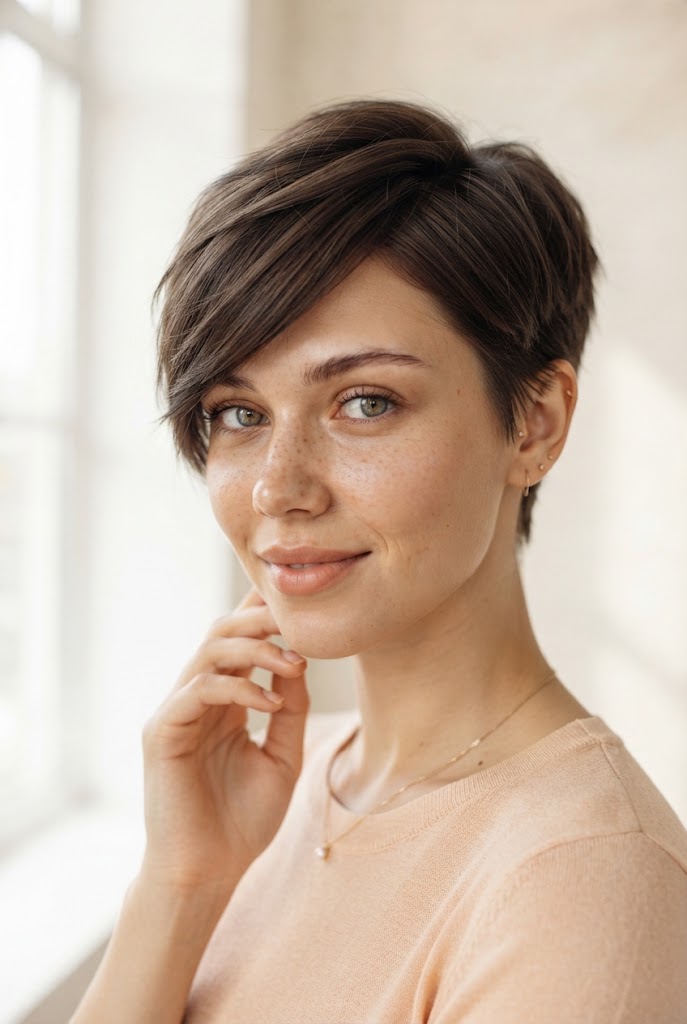
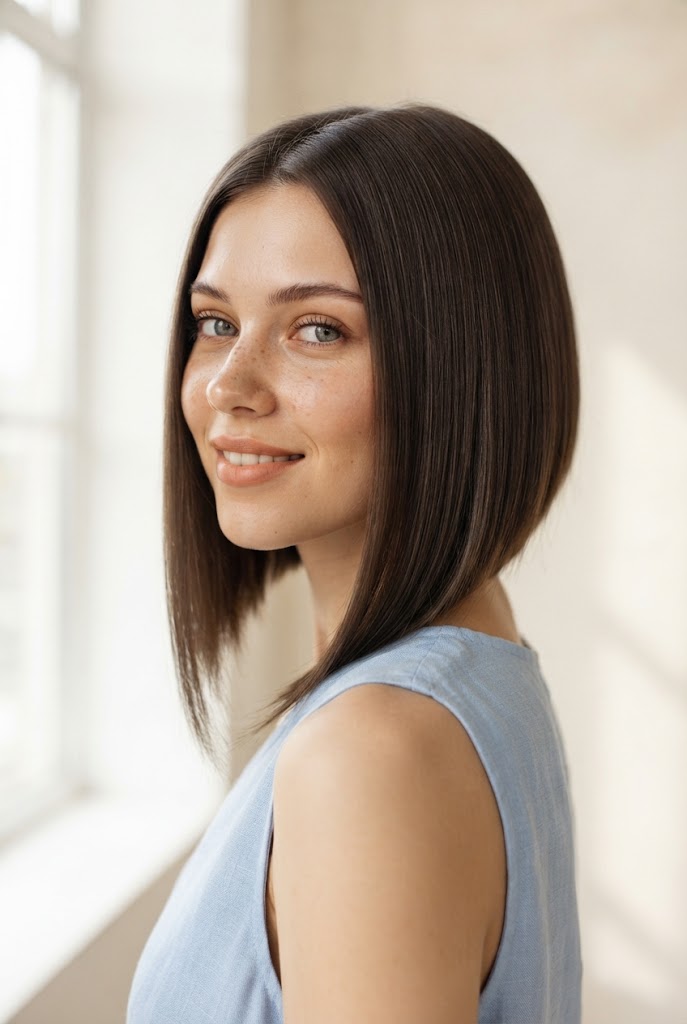
An angled bob creates definition by using a deliberate change in length. The back is shorter while the front gradually becomes longer, creating diagonal lines that move away from the widest area of the face. This makes it a particularly useful option if you like the polished appearance of a bob but do not want a perfectly round silhouette.
The front can be cut around the jaw or slightly below it depending on your features and how much length you want. Straight hair showcases the angle clearly, while wavy hair gives it a softer, more relaxed finish.
Fine hair can benefit from a relatively clean perimeter because too many layers may make the ends look sparse. Thick hair may need internal weight removal so the sides do not become overly full.
At the salon, ask for a graduated or angled bob that is shorter at the nape and gradually lengthens toward the front.
Best for: Straight-to-wavy hair and anyone who wants a structured cut.
3. Side-Swept Pixie
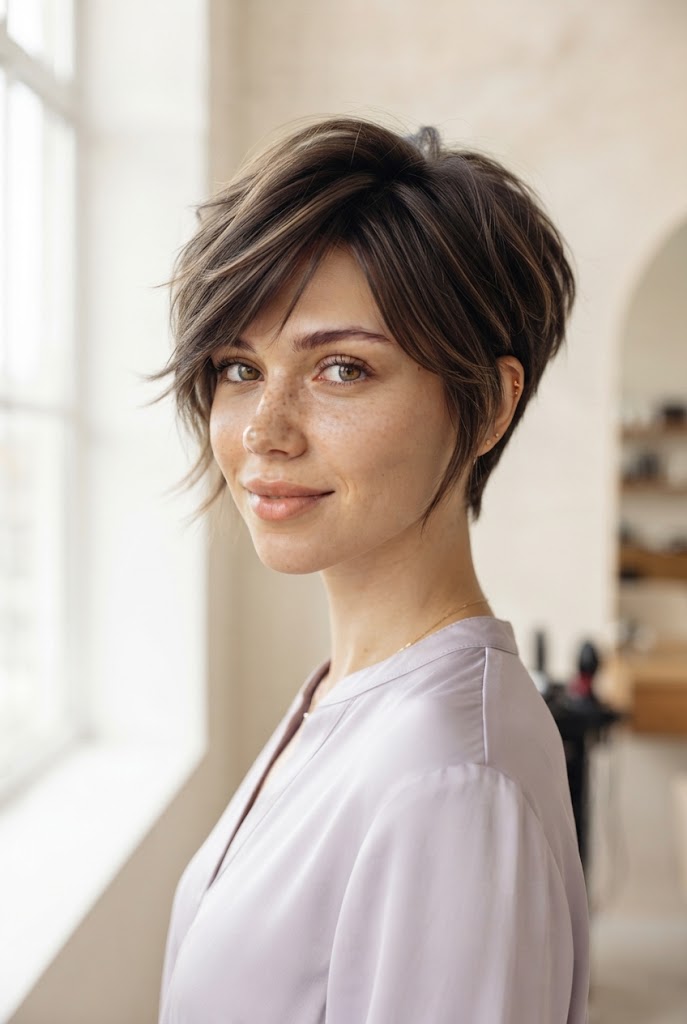
A side-swept pixie uses asymmetry to break up the visual roundness of the face. Instead of a straight fringe crossing the forehead horizontally, the longer front section sweeps diagonally across it. That diagonal line gives the haircut movement and keeps the overall shape from feeling too symmetrical.
The sides can be tapered close to the head while the top remains long enough to sweep forward or sideways. This makes the haircut especially useful for someone who wants a very short style but still wants a softer frame around the forehead.
Fine hair often benefits from this shape because the longer top can be lifted at the roots. Thick hair may require strategic thinning or internal layering to prevent the top from becoming heavy.
Use a small amount of styling cream or mousse rather than a heavy wax that can flatten the crown.
Best for: Fine-to-medium hair, straight or slightly wavy textures.
4. Layered Bixie
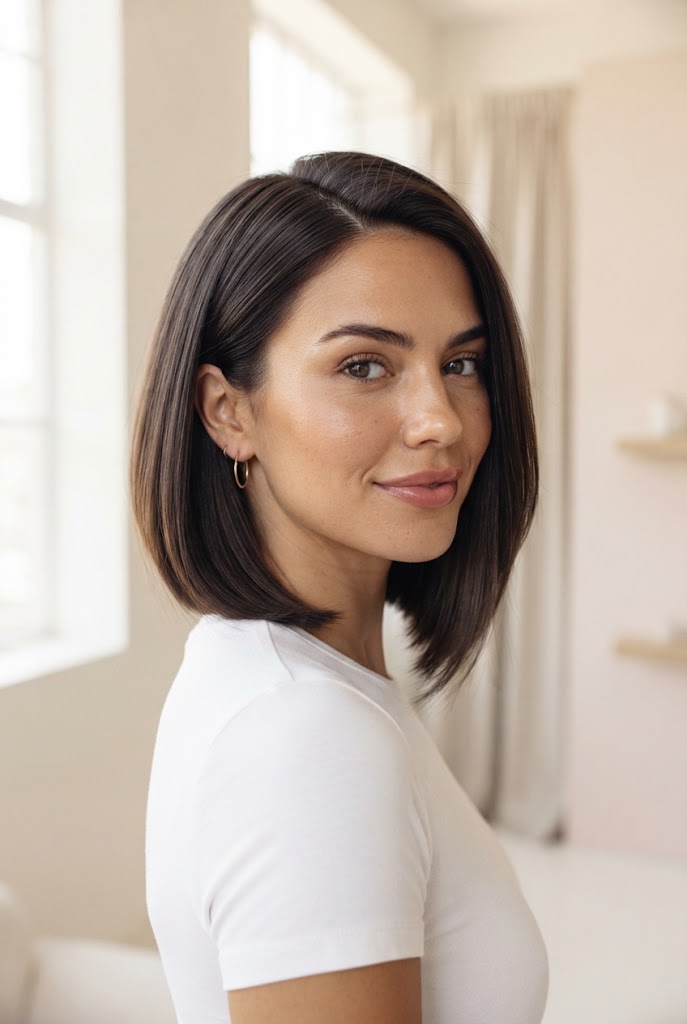
The bixie sits between a bob and a pixie, making it an excellent compromise for anyone who wants short hair without committing to an ultra-short crop. Its combination of shorter layers and slightly longer perimeter pieces gives the hairstyle movement without creating excessive width around the cheeks.
For a round face, the most useful version usually has more height toward the crown and controlled length around the front. The longer pieces can frame the cheekbones and jaw rather than stopping exactly at the widest point of the face.
A bixie is also useful during a pixie grow-out because it provides a transitional shape rather than leaving you with an awkward in-between stage. Fine hair can gain body from the layered structure, while thick hair may need weight removed underneath.
Ask for a short layered shape with a cropped back, longer top, and face-framing front pieces.
Best for: Fine, medium, thick, straight, or wavy hair.
5. Asymmetrical Bob
An asymmetrical bob introduces definition through uneven lengths. One side is slightly shorter while the opposite side extends farther, creating a strong visual line that prevents the haircut from looking circular.
You do not need an extreme difference between the two sides. A subtle asymmetry can be enough to create movement while keeping the haircut appropriate for everyday wear. A deeper side part can emphasize the effect and create additional height near the crown.
This cut is particularly attractive on straight hair because the asymmetry remains easy to see. Wavy hair creates a softer interpretation with more movement through the ends.
Maintenance depends on how dramatic the angle is. The stronger the asymmetry, the more noticeable the grow-out becomes. If you prefer fewer salon visits, choose a gentler difference in length.
Best for: Straight or wavy hair and anyone who likes modern, polished cuts.
6. Short Layered Bob

Like classic bob layer cut hairstyles, a short layered bob can create shape without looking overly severe. The key is where the layers begin. Instead of putting the shortest layers directly across the fullest part of the cheeks, ask for movement that supports the crown and gradually frames the lower face.
This approach is especially helpful for medium-to-thick hair because layers can remove bulk and make the haircut easier to style. Fine hair should receive lighter, more strategic layering so the perimeter does not become too thin.
A slight side part can add additional asymmetry, while a soft bend through the ends keeps the haircut from looking stiff. If you prefer air-drying, ask for layers that work with your natural texture rather than requiring a perfectly smooth blowout.
Best for: Almost all hair types when the layering is customized.
7. French Bob with Side-Swept Fringe
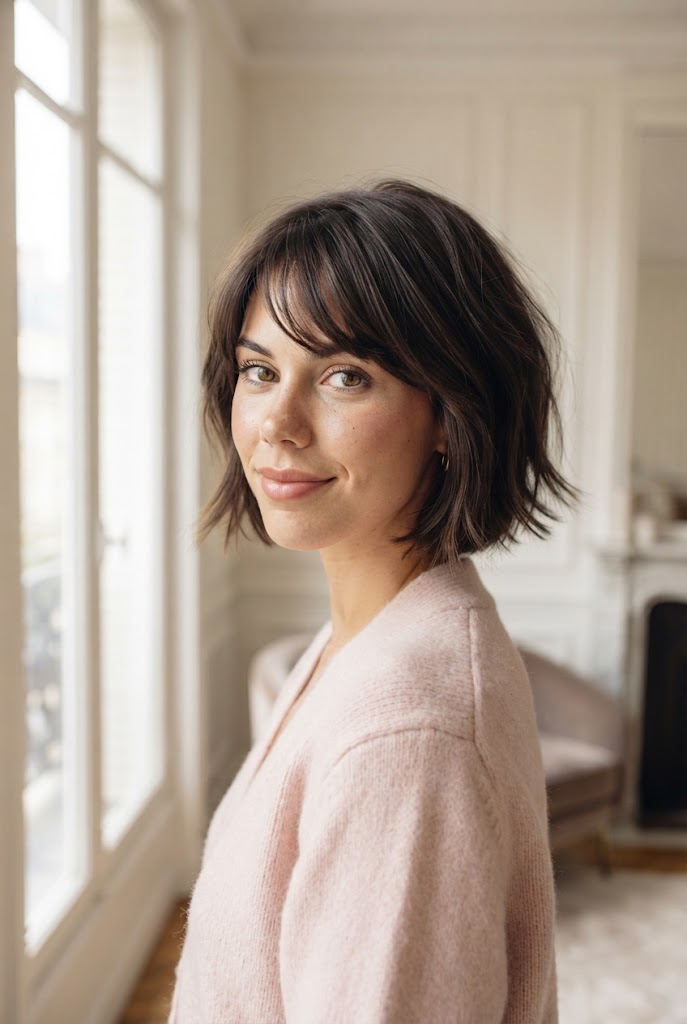
A classic French bob can work on a round face when its proportions are adapted rather than cut as a perfectly rounded shape. A side-swept fringe introduces a diagonal line, while a slightly longer front or softly textured perimeter keeps the haircut from creating excessive width around the cheeks.
This version feels polished but not overly formal. Straight hair gives it a clean Parisian-inspired finish, while naturally wavy hair makes the cut more relaxed.
The fringe does require some maintenance. If you dislike styling bangs every morning, ask for a longer, wispy side fringe rather than a very short, precise one.
A useful salon request would be: “I want a French-inspired bob with soft texture, a slightly elongated front, and a side-swept fringe rather than a heavy straight-across bang.”
Best for: Fine-to-medium straight or wavy hair.
8. Graduated Bob

A graduated bob creates fullness toward the back while keeping the front more controlled. That difference in shape can give the haircut a defined silhouette without requiring excessive volume around the cheeks.
It is particularly useful for fine hair because graduation can create the appearance of density at the back of the head. The crown can also be subtly lifted, helping create a more vertical profile.
For thick hair, the stylist may need to remove internal weight so the graduated shape does not become too bulky. Curly hair can wear a modified version, although the graduation needs to account for shrinkage and curl pattern.
This is a structured haircut, so it looks best when the shape is intentionally maintained. However, a softer graduation can grow out more naturally than an extremely precise geometric version.
Best for: Fine-to-medium hair, especially straight textures.
9. Short Shag
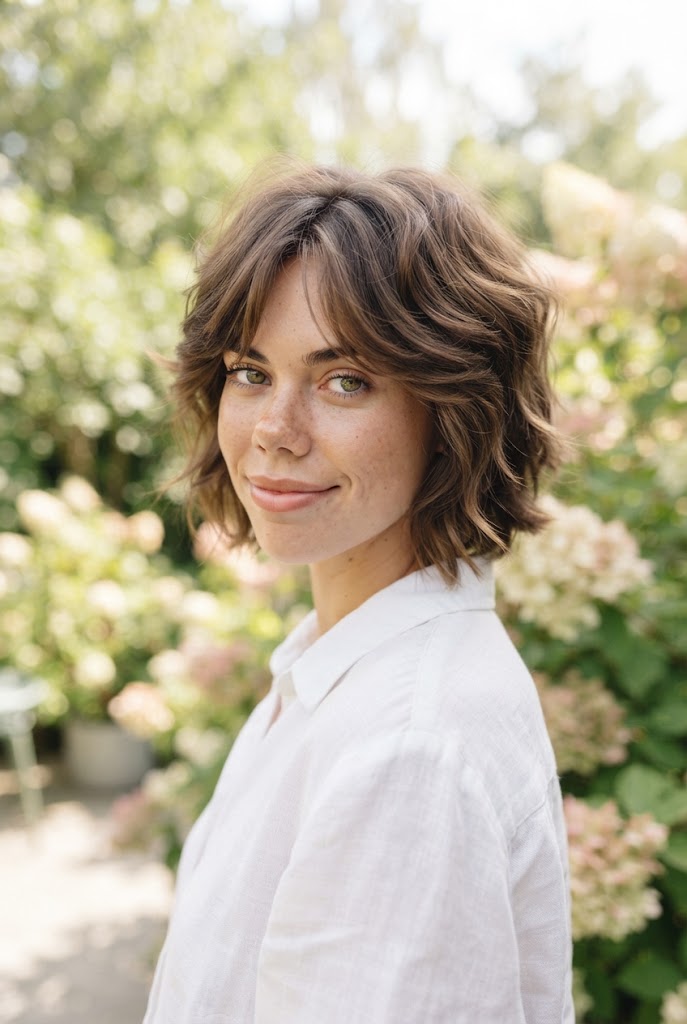
A short shag brings texture, layers, and movement into one haircut. Rather than creating a smooth, symmetrical outline, the shag uses strategically separated layers to create a lighter, more vertical shape.
This makes it especially interesting for naturally wavy or curly hair. The texture gives the haircut character without requiring perfectly straight styling. For a round face, keeping some lift around the crown while avoiding excessive fullness directly beside the cheeks helps the cut feel more balanced.
Straight hair can also wear a short shag, but you may need a texturizing spray or lightweight styling cream to bring out the piecey layers.
The grow-out is generally more forgiving than a highly geometric bob, although the shape can become less defined if the layers grow too long.
Best for: Wavy, curly, or textured hair.
10. Tapered Textured Crop

A tapered crop is a practical option if you want a genuinely short haircut with a clean outline. The sides and nape are kept close while the top remains longer and textured. That contrast creates definition without relying on long hair around the face.
The top can be styled upward, slightly forward, or toward one side depending on your preference. For a round face, directing some of the texture upward rather than outward can help maintain a balanced silhouette.
Thick hair benefits from the weight removal inherent in a tapered crop. Fine hair can use texture to create a fuller-looking top, although very low-density hair may need a softer version of the cut.
This is not the lowest-maintenance haircut in terms of salon appointments because the taper becomes noticeable as it grows.
Best for: Fine-to-thick straight or wavy hair.
11. Long Pixie with Side Part
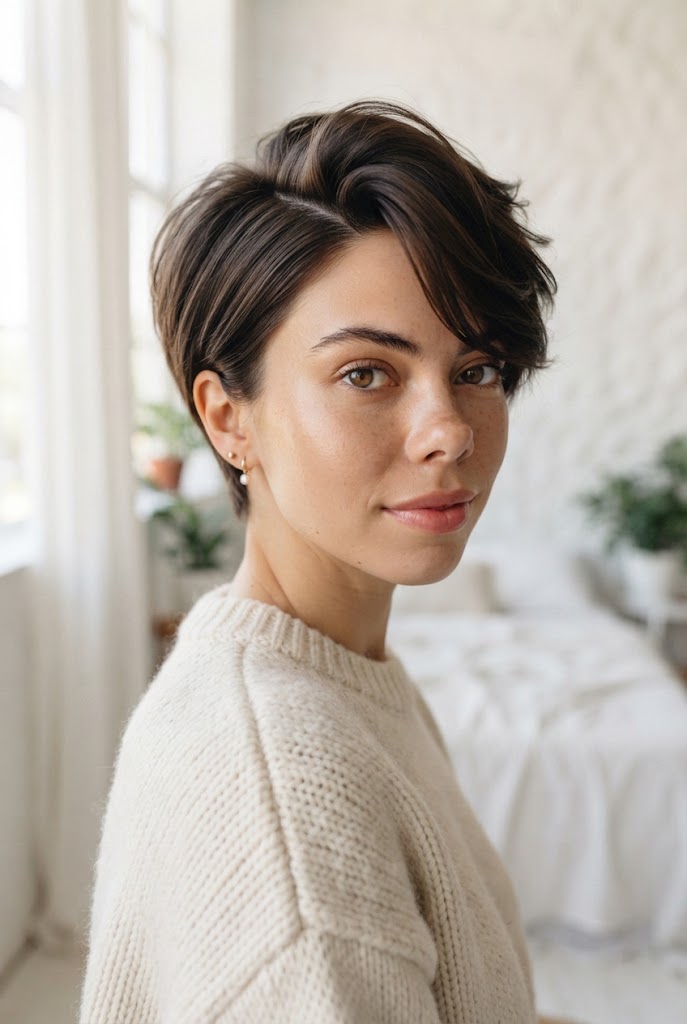
A long pixie is ideal if you want the benefits of a pixie without feeling completely exposed around the face. The extra length through the crown and front gives you more styling possibilities, while shorter sides keep the silhouette compact.
A side part is particularly useful because it introduces an angled line across the forehead. You can sweep the front across the face, tuck it behind one ear, or lift it slightly for more height.
This cut can be excellent for thick hair when the stylist removes internal weight without making the ends excessively thin. Fine hair can benefit from keeping enough length to create movement and volume.
It also makes a good transitional haircut for someone growing out a shorter pixie.
Best for: Straight, wavy, fine, or thick hair.
12. Short Bob with Curtain Bangs
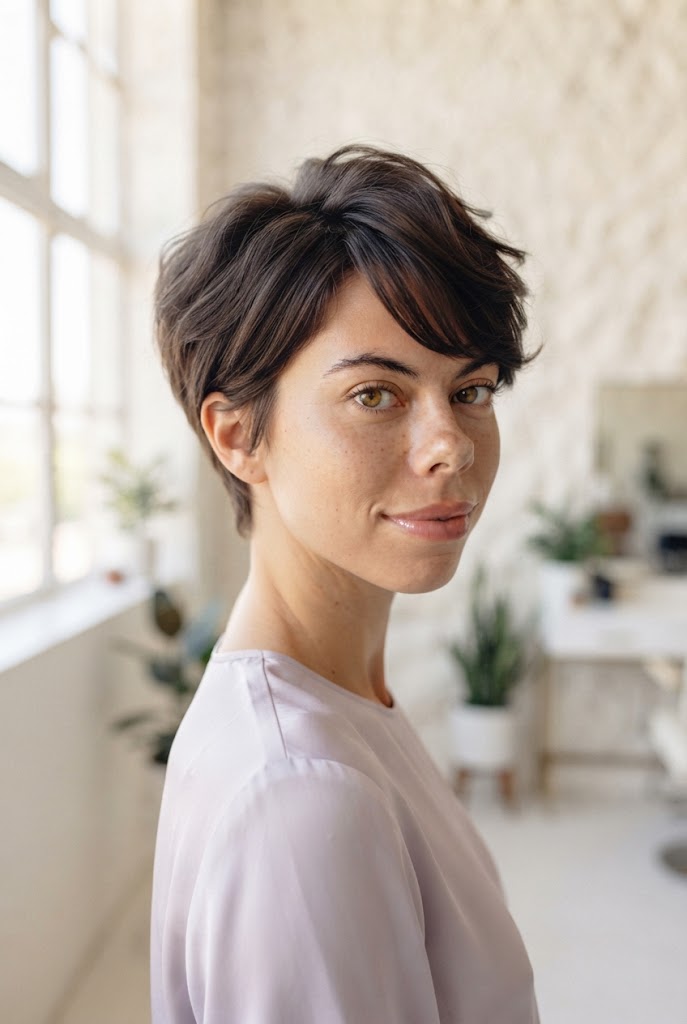
Curtain bangs can soften a short bob while creating a center-opening shape that draws attention toward the eyes. The important detail for a round face is keeping the bangs light and graduated rather than creating a dense horizontal line across the forehead.
The bob itself can sit around the jaw or slightly below it, depending on your preferred length. Longer curtain pieces that blend into the sides are especially versatile because they can be styled away from the face or allowed to frame the cheeks.
Fine hair can benefit from lightweight curtain bangs, while thick hair may need more internal shaping to keep the fringe from becoming heavy.
If you want low daily maintenance, ask for longer curtain bangs that naturally split and blend into face-framing layers.
Best for: Straight, wavy, fine, and medium-density hair.
13. Curly Short Bob with Lifted Crown

Curly hair does not need to be hidden or straightened to complement a round face. A short curly bob can look beautiful when the curls are shaped to create lift through the crown while avoiding excessive bulk directly at cheek level.
The haircut needs to account for curl shrinkage. Cutting curly hair wet without considering its natural spring can produce a much shorter result than expected.
Layers should be carefully placed so the curls have room to move without creating a triangular or overly rounded silhouette. A side part can add another layer of asymmetry.
Use lightweight curl cream or mousse and allow the curls to dry naturally or with a diffuser. Avoid heavy products that pull the crown down.
Best for: Naturally curly hair with medium-to-high density.
14. Feathered Short Crop with Side Fringe
A feathered crop gives a softer interpretation of short hair. Instead of sharp, heavily disconnected layers, the ends are tapered and feathered so they move naturally away from the head.
The side fringe adds another diagonal element, making the haircut especially useful if you want definition without an edgy or severe appearance. The crown can be lightly layered to create lift while the sides remain relatively controlled.
Fine hair can look fuller when the feathered pieces are kept substantial rather than over-texturized. Thick hair may need more internal weight removal.
This cut is also flexible for styling. It can be smoothed for a polished appearance or tousled with texture spray for a casual finish.
Best for: Fine-to-medium straight or wavy hair.
15. Textured Short Bob with Deep Side Part

A deep side part can completely change the balance of a short bob. Instead of creating a symmetrical shape that follows the natural roundness of the face, the part introduces an obvious diagonal line and allows more volume to sit toward one side.
The bob can be cut around the jaw or slightly below it, with subtle texture through the ends. For round faces, avoiding excessive outward fullness at cheek level is more important than simply choosing a particular bob length.
Fine hair can benefit from a deep side part because it creates the appearance of additional root lift. Thick hair may need internal layers to prevent the heavier side from becoming too bulky.
This is one of the easiest options to adapt between polished and casual styling.
Best for: Straight-to-wavy hair with fine-to-thick density.
How to Choose the Best Short Haircut for a Round Face
There is no single “correct” haircut for a round face. The most useful approach is to look at proportion rather than rules.
If your goal is a more elongated appearance, look for:
- Height through the crown
- Longer pieces around the front
- Side parts
- Side-swept fringe
- Asymmetrical shapes
- Controlled volume around the cheeks
- Layering that creates movement
- Tapered sides
- Angled or graduated outlines
Current hairstyle guidance consistently emphasizes these elements because they create vertical or diagonal movement rather than reinforcing a rounded silhouette.
That does not mean you have to avoid every blunt bob, fringe, or rounded haircut. The final effect depends on the exact length, density, texture, styling, and proportions of your individual face.
Best Short Haircuts for Round Faces by Hair Type
Fine Hair
When exploring short hairstyles for fine hair, shorter shapes often benefit delicate strands because removing excess length can make the hair easier to lift. A textured pixie, graduated bob, bixie, or side-parted crop can create the appearance of more body.
Avoid excessive texturizing through already-fine ends. Too much thinning can make the haircut look less dense.
Thick Hair
When considering short haircuts for thick hair, natural volume, but that volume needs to be directed strategically. Layered bobs, tapered crops, bixies, and textured pixies can remove weight while maintaining shape.
Ask your stylist about internal weight removal rather than simply thinning the perimeter aggressively.
Straight Hair
Straight hair shows haircut structure very clearly. Angled bobs, asymmetrical bobs, graduated bobs, and side-parted pixies are particularly effective because their lines remain visible.
A clean cut can also make the hair appear more polished with minimal styling.
Wavy Hair
Wavy hair naturally provides movement, making it a good match for short shags, textured bobs, bixies, and layered crops.
The goal is to enhance the natural wave instead of forcing the haircut into a perfectly geometric shape.
Curly Hair
Curly hair requires more attention to shrinkage, curl pattern, and volume distribution. A curly short bob or carefully shaped crop can be beautiful, but the stylist should account for how the curls behave when dry.
A lifted crown and controlled cheek-level volume can create a balanced shape.
Best Low-Maintenance Short Haircuts for Round Faces
If you want a short haircut without spending significant time styling every morning, consider:
- Textured pixie — quick to reshape with a small amount of styling product.
- Soft layered bob — especially when your natural texture already has movement.
- Bixie — provides flexibility without requiring a perfectly polished finish.
- Short shag — naturally benefits from tousled texture.
- Long pixie — can be air-dried or styled in several directions.
Remember that daily maintenance and salon maintenance are different things. A pixie may take only five minutes to style but require frequent trims to keep its silhouette. A softer bob may take slightly longer to style but grow out more gradually.
Short Haircuts for Round Faces You Can Tie Back
Not every short haircut can be pulled into a ponytail.
If tying your hair back matters to you, choose a long pixie, bixie, longer bob, or jaw-to-neck-length bob rather than an ultra-short pixie. Front pieces may still fall out, so clips, small elastics, or a headband can help.
For workouts, work, or busy mornings, a longer bob is usually more practical than a traditional pixie because you retain enough length to secure at least part of the hair.
If you want both short hair and ponytail flexibility, tell your stylist that tie-back ability is a priority before deciding on the final length.
Pixie vs. Bob for a Round Face
| Feature | Pixie | Bob |
| Visual height | Excellent | Good |
| Face framing | Depends on top/front length | Excellent |
| Styling flexibility | Moderate | High |
| Ponytail potential | Low | Medium to high |
| Salon maintenance | Higher | Moderate |
| Fine-hair volume | Excellent | Very good |
| Boldness | High | Moderate |
| Grow-out | More noticeable | Usually easier |
A pixie is a stronger choice if you want maximum lift and a major transformation. A bob is better if you want more styling options and some length around the face.
The bixie sits between the two and can be a useful compromise. Current round-face hairstyle coverage frequently identifies the bixie as a flexible middle ground because it combines a shorter back and layered structure with more length around the face.
What to Tell Your Stylist
Instead of simply saying, “I want a haircut for a round face,” explain what you want the haircut to accomplish.
You could say:
“I want a short haircut that keeps the sides controlled and creates some height through the crown.”
For a bob:
“I’d like a bob with a slightly longer front and enough movement that it doesn’t become bulky around my cheeks.”
For a pixie:
“I’d like the sides and nape tapered, but I want enough length on top for texture and a side sweep.”
For a bixie:
“I’d like a cropped back with longer, softer pieces around the face so I have some styling flexibility.”
Also bring photos showing the front, side, and back whenever possible. A reference photo communicates proportions much more effectively than a haircut name alone.
Are Short Haircuts Good for Round Faces?
Yes. A round face does not automatically mean you need long hair.
The most important consideration is shape. Short hair can be flattering when the haircut introduces height, diagonal movement, controlled sides, or strategically placed length. Pixies, bobs, bixies, shags, and cropped cuts can all work when customized to the individual.
The idea that every round face needs long, straight hair is far too restrictive. Current professional and editorial hairstyle guidance includes numerous short options specifically designed around crown lift, asymmetry, texture, and face-framing.
Frequently Asked Questions
What is the best short haircut for a round face?
A textured pixie, angled bob, bixie, or layered bob can all work well. The best choice depends on whether you want more height, more length around the face, easier styling, or a more dramatic transformation.
Is a pixie cut good for a round face?
Yes. A pixie can be especially effective when the sides are controlled and the crown has some height or texture. A side-swept fringe can also introduce a flattering diagonal line.
Does short hair make a round face look rounder?
Not necessarily. The proportions of the haircut matter more than simply having short hair. Excessive width around the cheeks can emphasize roundness, while height, angles, and controlled sides can create more definition.
Is a bob flattering on a round face?
Yes. Angled, layered, asymmetrical, graduated, and side-parted bobs are particularly adaptable. The most important consideration is avoiding unnecessary bulk exactly where the face is widest.
Should round faces have bangs?
They can. Side-swept, wispy, and curtain bangs can create movement and soften the overall shape. If you want to visually lengthen the face, very heavy horizontal bangs may not be the only option worth considering.
What short haircut is best for fine hair and a round face?
A textured pixie, graduated bob, bixie, or side-parted short bob can work well. Fine hair generally benefits from strategic layering rather than aggressive thinning.
What short haircut is best for thick hair and a round face?
A tapered textured crop, layered bob, bixie, or textured pixie can help remove excess weight while maintaining shape. Internal weight removal can be particularly useful.
Can curly hair be cut short with a round face?
Absolutely. A curly bob, cropped shag, or shaped curly crop can work beautifully. The haircut should account for shrinkage and keep the curl volume balanced rather than automatically removing all fullness.
How often should a short haircut for a round face be trimmed?
Very short pixies and precise bobs generally need more frequent maintenance than softer layered cuts. Your ideal schedule depends on how quickly your hair grows and how precisely you want to maintain the original shape.
Can I grow out a short haircut without an awkward stage?
Yes, but some cuts are easier to grow out than others. A bixie or longer pixie can provide a useful transition, while heavily asymmetrical or highly tapered cuts may require more reshaping during the grow-out process.
Final Takeaway
The best short haircuts for round faces are not about hiding your face shape. They are about controlling proportion.
If you want more definition, look for a cut that gives you at least one of these elements: crown height, diagonal movement, longer front pieces, tapered sides, or strategic texture.
A textured pixie offers maximum lift. An angled bob creates length through its front pieces. A bixie gives you a middle ground between short and versatile. A short shag works beautifully with natural texture, while a graduated or layered bob can provide structure without sacrificing softness.
Most importantly, choose the haircut around your actual hair density, texture, styling routine, and willingness to maintain it. A technically flattering haircut that you dislike styling will never be as useful as a customized cut that fits your everyday life.