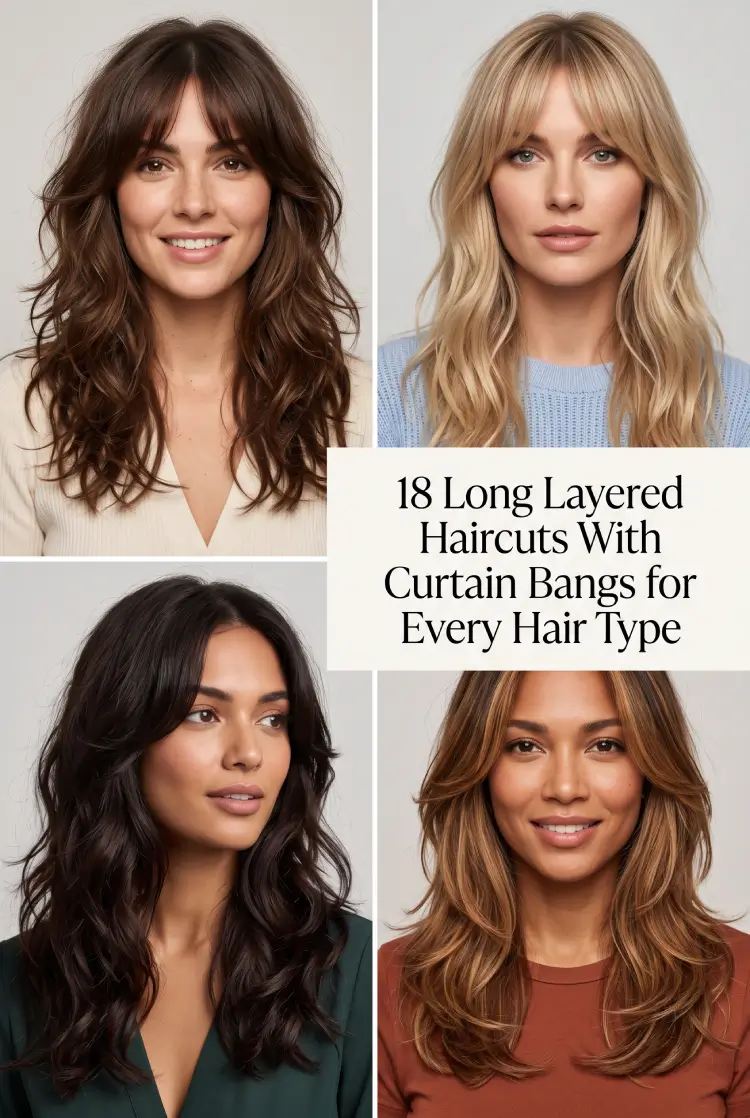
Long hair can start to feel visually heavy when it grows without a clear shape. Curtain bangs solve part of that problem by bringing attention back toward the face, while layers keep the lengths from looking like one solid sheet. For related styling inspiration, explore how to choose the right hairstyle.
That combination is why long layered haircuts with curtain bangs work across so many aesthetics. You can keep the ends relatively full and polished, add dramatic butterfly layers, lean into a 70s feathered shape, or embrace natural curls and coils. The important part is matching the layering technique to your density and texture rather than choosing a reference photo based only on its appearance.
The 18 ideas below cover the major long-layered and curtain-bang variations found in the reference article, with additional guidance for choosing, styling, maintaining, and explaining each cut to a stylist.
Quick Picks: Which Long Layered Cut Should You Choose?
| Your priority | Variation to consider |
| Classic, versatile shape | Classic long layers with curtain bangs |
| Maximum face framing | Butterfly cut with curtain bangs |
| Natural movement | Long shag with curtain bangs |
| Edgier texture | Long wolf cut with curtain bangs |
| Defined back shape | Long V-cut with curtain bangs |
| Retro volume | 70s feathered layers |
| Subtle layering | Invisible layers |
| Natural curls | Long curly layers |
| Coily natural hair | Long coily hair with curtain-bang effect |
| Beachy texture | Long beachy waves |
| Piecey texture | Long razored layers |
| Warm blonde dimension | Honey blonde layers |
| Brunette warmth | Caramel balayage |
| Fuller fringe shape | Bottleneck bangs |
| Light fringe | Wispy curtain bangs |
| Asymmetrical framing | Side-parted curtain bangs |
| Cool brunette color | Ash brunette layers |
| Relaxed, undone texture | Bohemian layers |
1. Classic Long Layers With Curtain Bangs
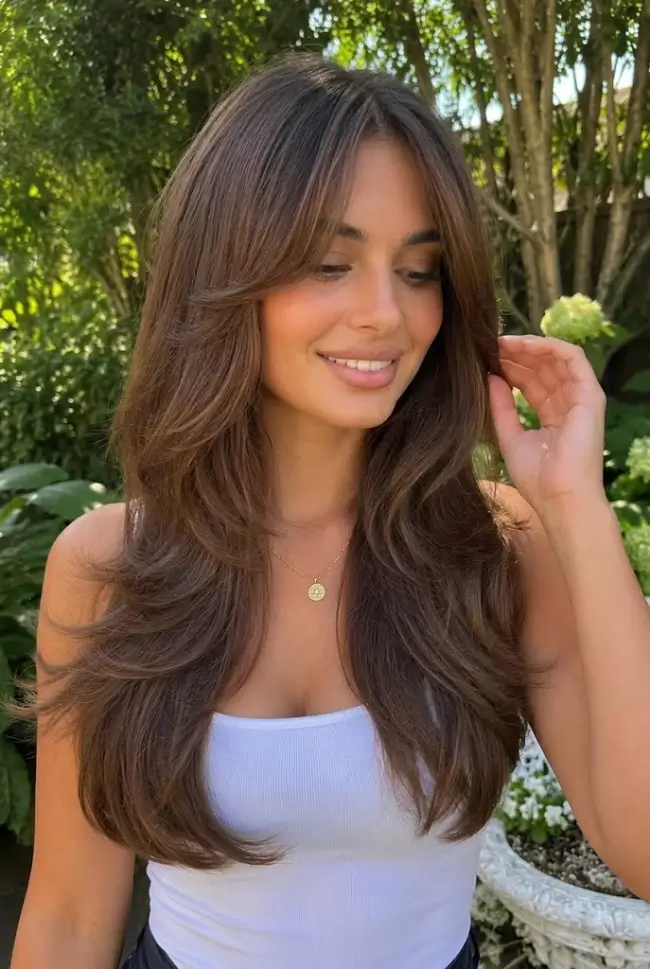
Classic long layers are the easiest starting point if you want your hair to remain recognizably long while gaining movement around the face and through the lengths. The layers are generally blended rather than sharply disconnected, and the curtain bangs open from a central or slightly off-center part before merging into the face-framing sections.
This version works particularly well for medium-density straight or wavy hair because the layering adds movement without requiring a dramatic change to the overall silhouette. Fine hair can also wear it, but excessive layering may make the ends appear thinner, so ask for a conservative amount of internal movement. Thick hair can benefit from strategically removing weight rather than simply adding many short layers.
For a round face, longer curtain pieces can visually lengthen the front profile; square faces may suit softer, sweeping edges. Styling ranges from air-drying with a light cream to a round-brush blowout. The grow-out is relatively forgiving. For the salon, ask for long blended layers, soft face-framing pieces, and curtain bangs that connect naturally into the first layer rather than stopping abruptly.
2. Butterfly Cut With Curtain Bangs
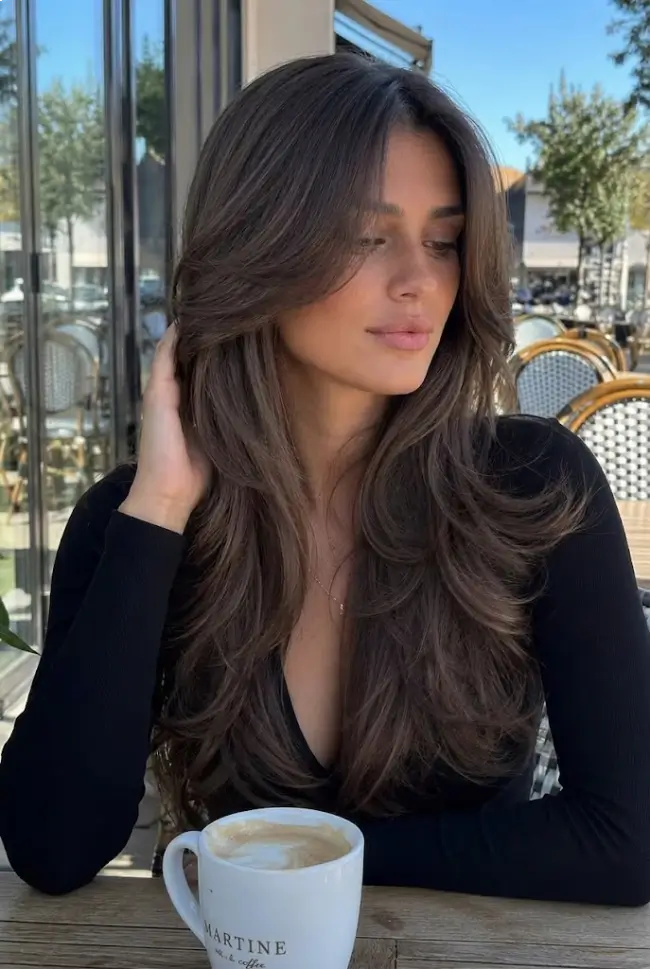
The butterfly cut creates a more noticeable contrast between shorter face-framing layers and the much longer back section. Adding curtain bangs intensifies that framing because the fringe becomes the first part of a cascade that continues through the cheekbones, jawline, and lengths.
This cut is particularly useful for someone who wants long hair but also wants a hairstyle that looks substantially layered from the front. Medium-to-thick hair usually has enough density to support the multiple visible layers, while very fine hair may need a more restrained version to prevent the perimeter from becoming sparse. Straight and wavy textures show the layered architecture clearly, although curls can also work when the cut is adapted to shrinkage and curl placement.
The tradeoff is styling. A butterfly cut looks most defined when the shorter layers are lifted with a round brush, blow-dry brush, or rollers. It can air-dry, but the shape may become less dramatic. Ask your stylist for long preserved length, shorter cheekbone-level framing, and layers that create separation without excessively thinning the ends. This is a stronger choice for someone who enjoys styling than for someone who wants a nearly maintenance-free haircut.
3. Long Shag With Curtain Bangs
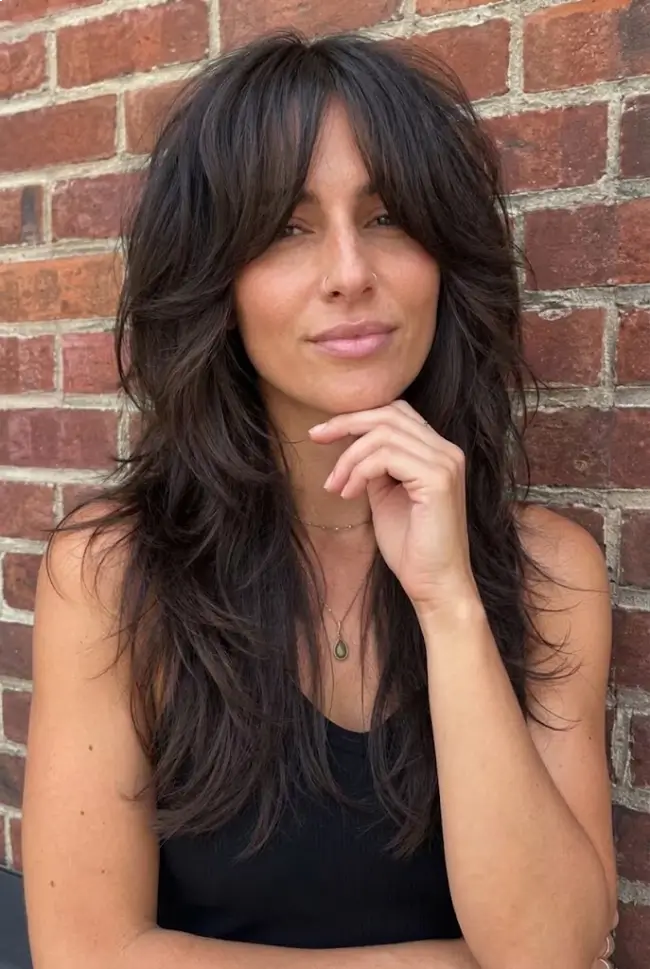
A long shag takes the layered concept much further. Instead of concentrating movement only around the lower lengths, the cut introduces shorter, more textured layers higher toward the crown and front. Curtain bangs fit naturally into that structure because they create a similarly soft, separated frame around the face.
This style tends to suit medium-to-thick hair especially well because the additional layering can distribute visual weight. Wavy hair is a natural match because the texture helps the layers separate without much work. Straight hair can wear the cut too, although you may need texture spray, a curling iron, or a rough air-dry technique to reveal the shaggy character. Curly hair requires more individualized cutting so that the shorter layers do not spring higher than intended.
The biggest consideration is that a shag sacrifices some fullness at the bottom in exchange for movement. That makes it less suitable if your priority is a thick-looking, one-length perimeter. For a stylist, describe it as a long shag with visible crown movement, soft curtain bangs, and enough length retained through the back to keep it from becoming a short shag. It is particularly practical for casual, textured lifestyles where a slightly undone finish is desirable.
4. Long Wolf Cut With Curtain Bangs
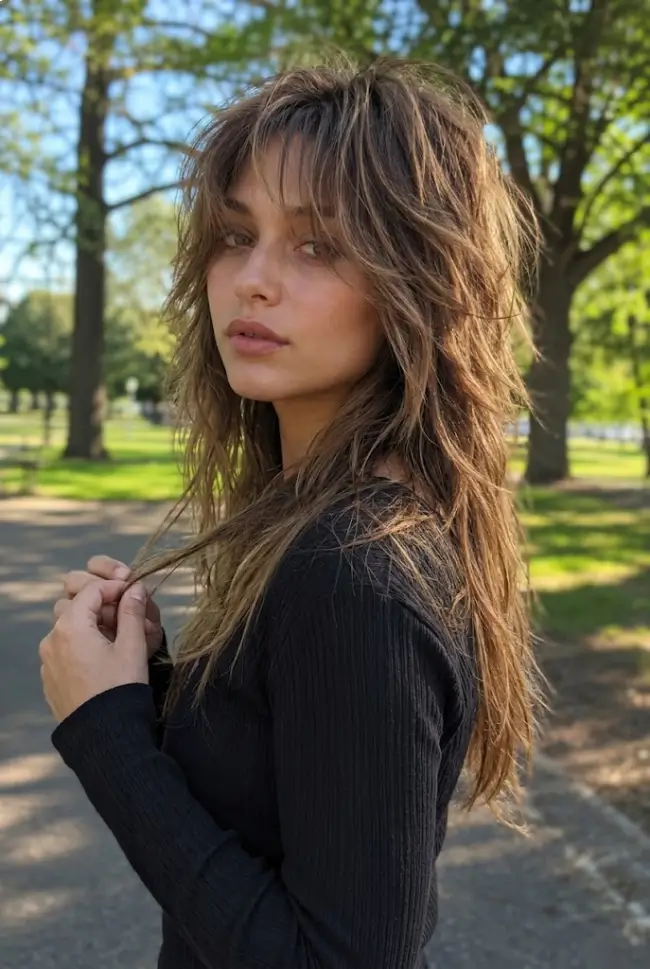
The long wolf cut combines substantial layering around the crown with longer lengths through the back, creating a more pronounced contrast than a conventional long layered haircut. Curtain bangs can be incorporated into the shorter upper sections so the front feels connected rather than appearing like a separate fringe.
This is a statement-oriented choice for someone who wants long hair but does not want the hairstyle to look traditionally polished. Thick or medium-density hair often has enough volume to support the shape, while fine hair may need careful placement to prevent the crown from becoming overly wispy. Naturally wavy hair is especially compatible because the texture helps the shorter layers separate. Straight hair can require more styling to produce the intended volume and pieceiness.
A wolf cut also changes how the hair behaves during grow-out. The shorter crown sections remain part of the silhouette for longer than they would in a conventional layered cut, so it is worth being comfortable with visible texture. Ask for a long wolf shape with substantial crown layers, longer back length, and curtain bangs that blend into the upper layers. A texture spray and air-drying can work well; a smooth blowout will produce a noticeably different result.
5. Long V-Cut With Curtain Bangs
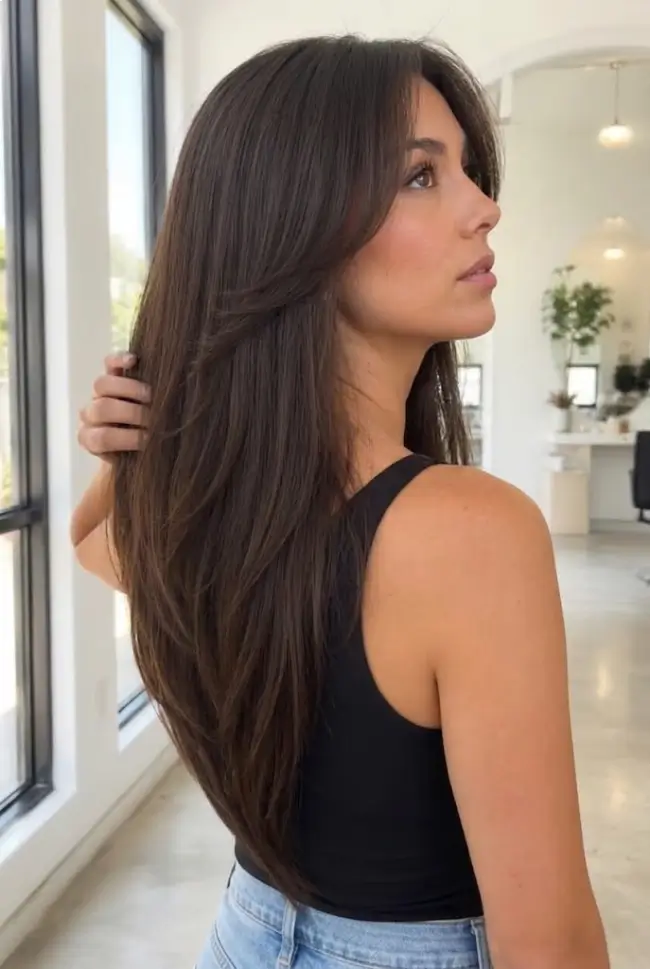
A V-cut creates a distinct shape at the back, with the center section remaining longer than the hair toward the sides. When combined with curtain bangs, the haircut has two visual focal points: face framing at the front and a pointed silhouette at the back.
This option is particularly effective on medium-to-thick hair because sufficient density helps the V shape remain visible. On very fine hair, a deep V can make the side lengths look considerably thinner than the center, so a shallow V or softer U shape may be more balanced. Straight hair emphasizes the geometry, while waves soften it and make the outline appear less precise.
Face shape matters less here than the relationship between your front framing and overall hair volume. The curtain bangs can be customized separately to suit the face. Maintenance is moderate because the back outline eventually loses definition as it grows. If you wear your hair in a ponytail frequently, the V shape can create a tapered ponytail rather than a fuller one. Tell your stylist you want long layers with a clearly defined but not overly extreme V perimeter, plus curtain bangs that connect into the front layers.
6. Long 70s Feathered Layers With Curtain Bangs
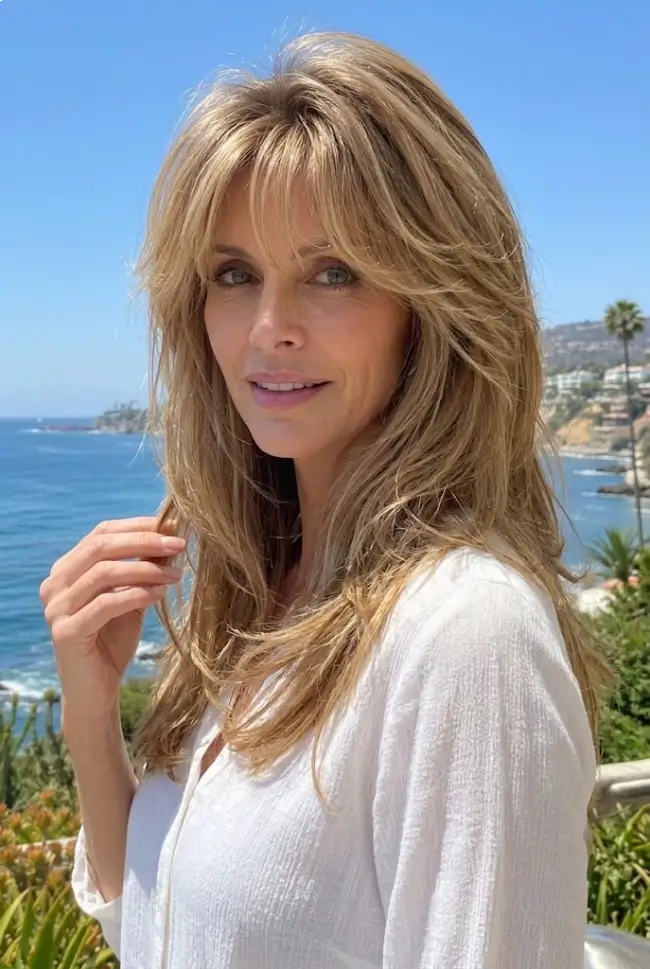
70s-inspired feathered layers bring movement outward and away from the face rather than simply removing weight from the ends. The curtain bangs become part of that sweeping shape, creating a continuous transition from the forehead toward the cheekbones and then into the longer layers.
Straight and slightly wavy hair generally shows feathering most clearly because the individual layers remain visible. Thick hair can also work beautifully, although the stylist may need to remove some internal weight before creating the feathered movement. Fine hair requires a lighter touch; too much layering can make the bottom appear thin.
This cut is more styling-dependent than invisible layers. A round brush, large rollers, or a blow-dry brush can help direct the face-framing pieces backward. Heat protectant is important whenever hot tools are used. The look can soften considerably when air-dried, which may be desirable if you prefer a modern interpretation rather than a highly defined retro finish.
For the salon, ask for long feathered layers that sweep away from the face, with curtain bangs blended into the feathered front rather than a blunt fringe. This is a good choice when movement and volume matter more than preserving a completely solid perimeter.
7. Long Invisible Layers With Curtain Bangs
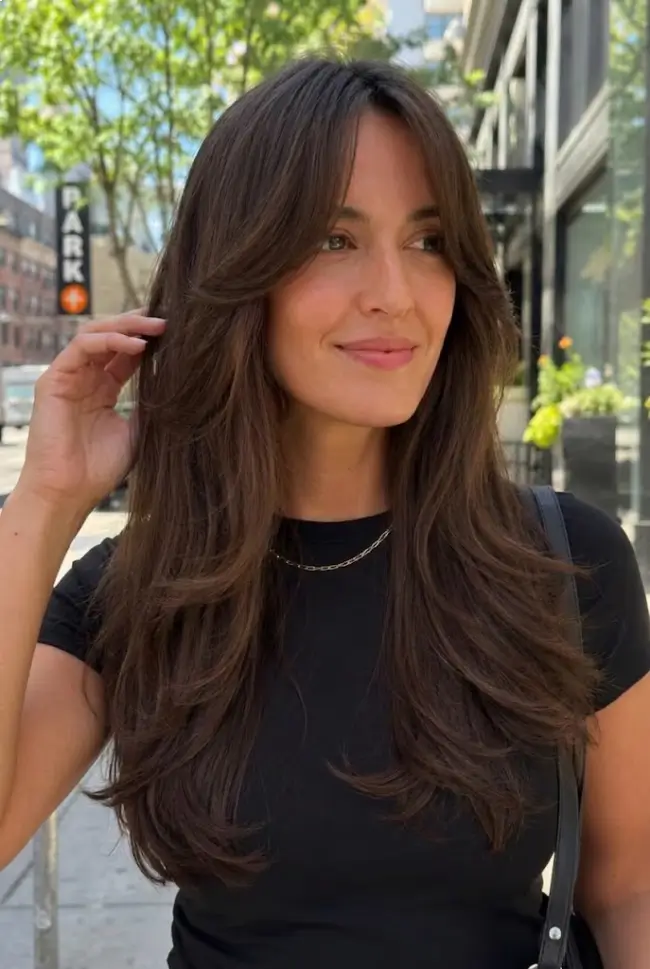
Invisible layers are designed to create movement without producing obvious steps between sections. The technique is useful when you like the appearance of long, healthy-looking hair but find completely one-length hair too heavy or flat.
This approach can be particularly helpful for fine-to-Modern haircuts for medium hair share similar face-framing benefits because the goal is not to dramatically remove bulk. The layers can be placed internally so the outer shape remains relatively full. Straight hair may show only subtle movement, while wavy hair can reveal more separation naturally. Thick hair can also benefit, although the stylist should decide whether invisible layering alone is enough to manage the density.
The curtain bangs provide the visible framing while the rest of the haircut remains understated. That makes this variation a good option for conservative workplaces, low-styling routines, or anyone growing out their hair who does not want a dramatic haircut. It also has a forgiving grow-out because the layers are blended rather than sharply defined.
Ask for very long, seamless internal layers with a strong, healthy-looking perimeter and soft curtain bangs that gradually connect into the front. A styling cream or lightweight smoothing product may be enough for daily wear.
8. Long Curly Layers With Curtain Bangs
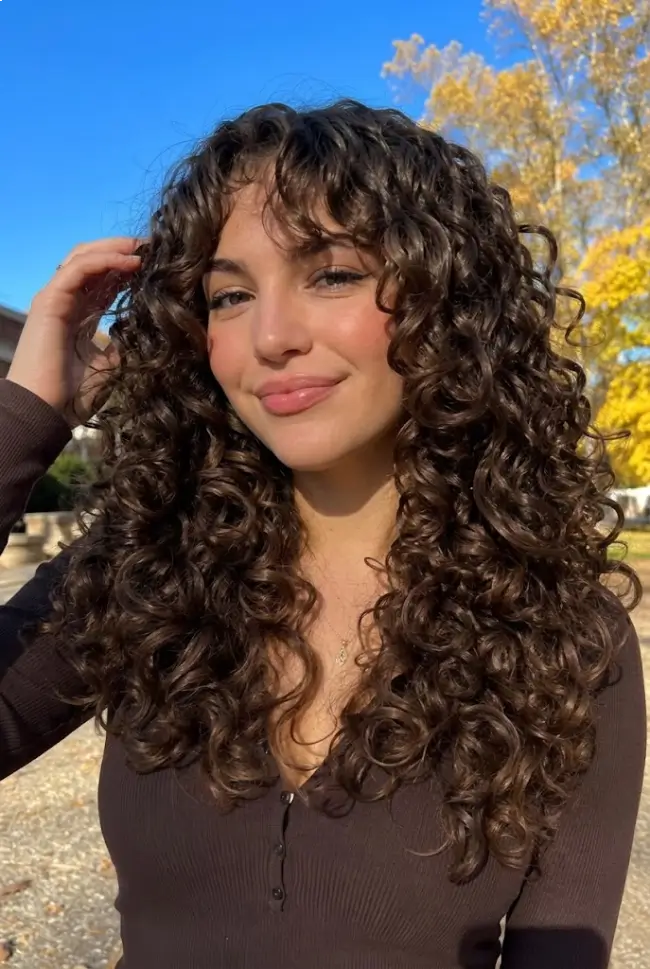
Long curly layers need to be designed around the curl pattern rather than treated like straight hair with extra bends. The position and length of each layer influence where curls expand, so the haircut should account for shrinkage, density, and the way the curls naturally group together.
Curtain bangs can work beautifully on curly hair when they are long enough and shaped to spring into place rather than being cut according to their stretched length. Medium-to-dense curls often have enough volume to support a visible curtain effect. Fine curls may need fewer layers so the ends retain substance. Face shape can influence where the shortest front pieces begin, but curl behavior should remain a major consideration.
Styling is usually more about defining than reshaping. Curl cream or gel applied to wet hair can encourage consistent curl formation, followed by air-drying or diffusing. Brushing the hair after it dries may disrupt the intended pattern. Grow-out can be forgiving because curly layers naturally blend, although the front fringe may require more frequent shaping.
Tell your stylist you want long curl-preserving layers, curtain bangs adapted for your natural shrinkage, and enough length in the front that the bangs sit around the cheekbones when dry.
9. Long Coily Hair With a Curtain-Bang Effect
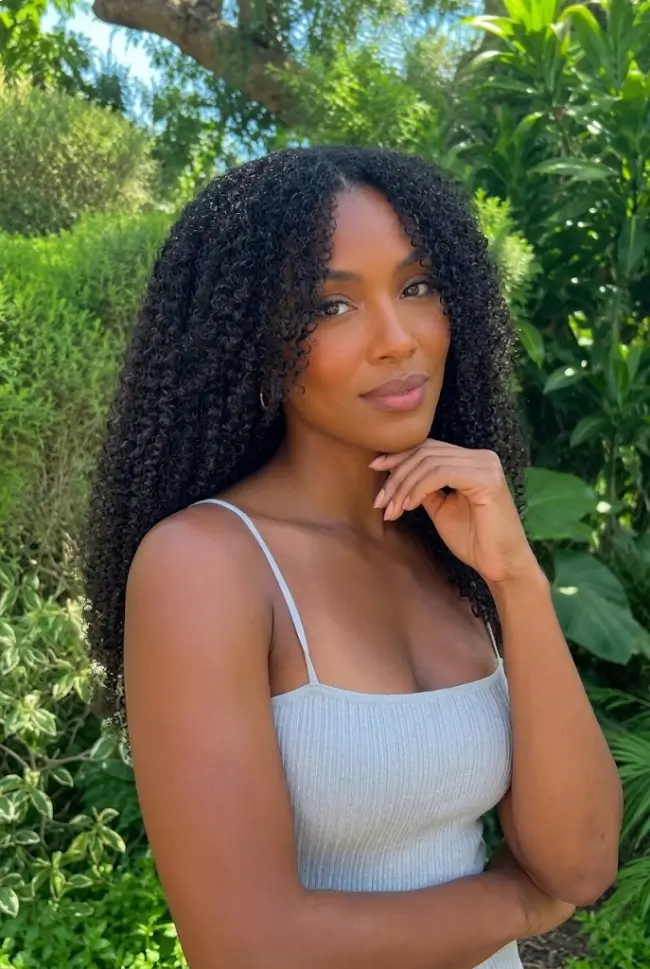
On long coily hair, a curtain-bang effect does not necessarily mean creating a conventional straight fringe. Instead, longer sections around the crown and front can be parted down the center and shaped to sweep outward, creating the visual openness associated with curtain bangs.
Density and shrinkage are particularly important. Coily hair can look considerably shorter when dry than when stretched, so the desired finished position should be discussed before cutting. The layering strategy should preserve enough structure to prevent the perimeter from appearing excessively thin while still allowing the hair to move.
This look can work beautifully with natural texture and does not require the hair to be heat-stretched. Curl-defining products can help the front sections maintain separation, while satin protection at night can reduce friction and help preserve the styling pattern. The maintenance schedule depends heavily on the chosen shape and natural hair routine.
For the consultation, explain the desired dry length and dry shape, then ask for long layers that respect the existing coil pattern and a center-parted front section that creates a soft curtain effect. Avoid relying on a reference image without discussing shrinkage because the same cut can look dramatically different on stretched and unstretched hair.
10. Long Beachy Waves With Curtain Bangs
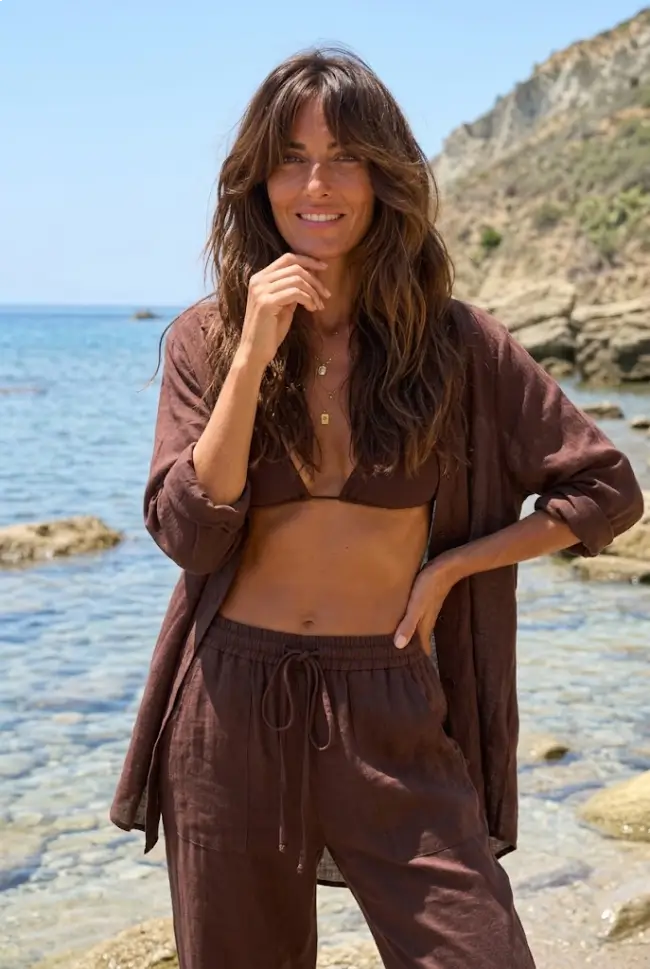
Long beachy waves give curtain bangs a softer, more casual setting. Instead of highly structured layers, the haircut usually relies on enough internal movement to allow waves to travel through the lengths without becoming one heavy mass.
Naturally wavy hair is the easiest starting point, particularly when the wave pattern is reasonably consistent from the front through the back. Straight hair can achieve the look with a curling iron, wand, rollers, or heatless techniques, but that makes the style more maintenance-intensive. Curly hair may also be adapted, although its natural curl pattern will produce a different finish.
Fine hair can benefit from strategic layering that creates movement without over-thinning the ends. Thick hair may need more internal weight management so the waves do not collapse under their own density. Curtain bangs can be waved away from the face or left softer and more natural.
A texturizing spray or lightweight styling cream can help, but avoid excessive product if you want loose movement. Ask for long layers that encourage natural wave separation, a soft perimeter, and curtain bangs that can blend into the first face-framing layer. This is a practical choice for casual lifestyles because imperfect waves generally suit the haircut.
11. Long Razored Layers With Curtain Bangs
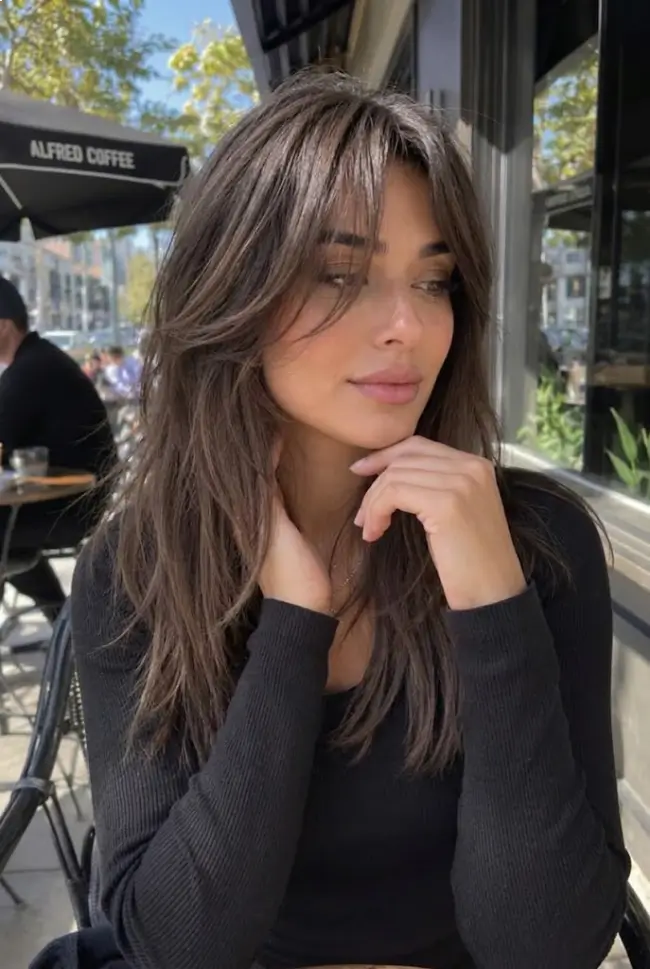
Razored layers create a lighter, more piecey appearance than a traditional scissor-cut layered shape. The ends tend to look softer and less uniform, which can make long hair feel more textured without dramatically reducing its overall length.
This technique is best considered in relation to your individual hair characteristics rather than treated as universally suitable. Straight and moderately wavy hair can reveal the separated texture clearly. Thick hair may benefit from the lighter movement, while very fine or fragile hair may require caution because excessive removal at the ends can make the perimeter appear sparse.
The curtain bangs can be shaped with the same textural philosophy, producing a less polished transition around the face. Styling can be relatively simple if you like an undone finish: work a lightweight texture product through damp or dry hair and allow the ends to separate naturally. A smooth round-brush blowout can work, but it changes the character of the cut.
Ask your stylist whether a razor is appropriate for your specific texture and say you want lightweight, piecey long layers while retaining enough density at the perimeter to keep the ends looking substantial. Regular shaping helps prevent the texture from becoming uneven during grow-out.
12. Long Layered Honey Blonde With Curtain Bangs
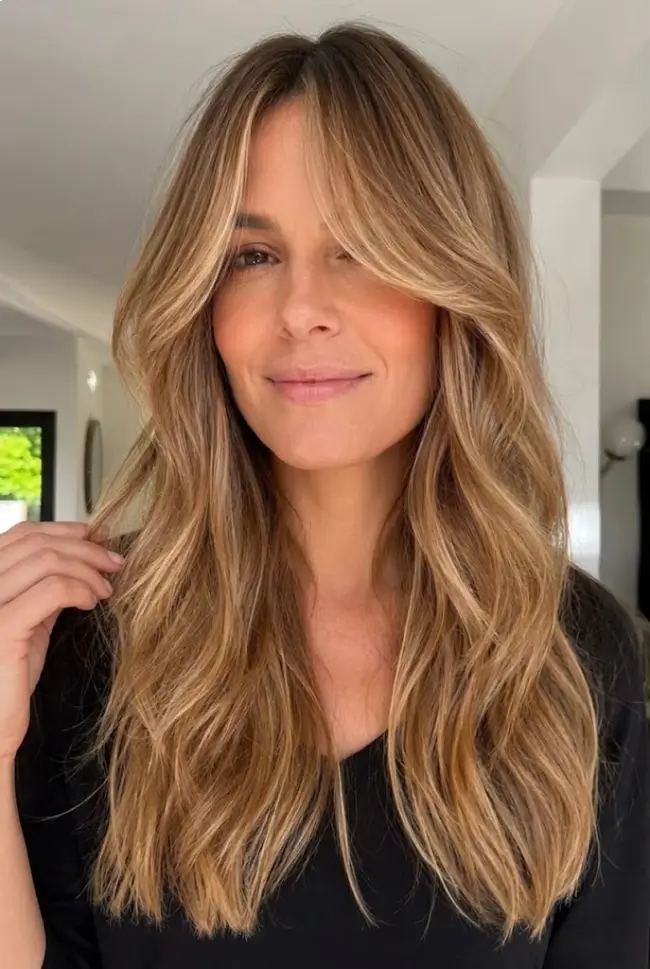
Honey blonde changes the visual effect of long layers because warm, golden tones can make the face-framing sections especially noticeable. When combined with curtain bangs, lighter pieces around the front can draw attention toward the eyes, cheekbones, and overall shape of the fringe.
The haircut itself can be adapted to fine, medium, or thick hair, but the color service adds another maintenance consideration. Lightening can require more attention to moisture, heat exposure, and color preservation than an untreated natural shade. Long hair also contains more length to maintain, so a good haircut should not rely entirely on color to create dimension.
A softer balayage approach can make the transition less obvious as the hair grows. If you want a more uniform honey blonde, the maintenance requirements may be different depending on how much your natural base is lifted. Use heat protectant when styling and avoid excessive heat on already-lightened lengths.
At the salon, describe the result as long blended layers with curtain bangs and warm honey-golden dimension concentrated subtly around the face. Bring a photo taken in natural light so your stylist can judge the relationship between the blonde tone and your starting color.
13. Long Caramel Balayage With Curtain Bangs
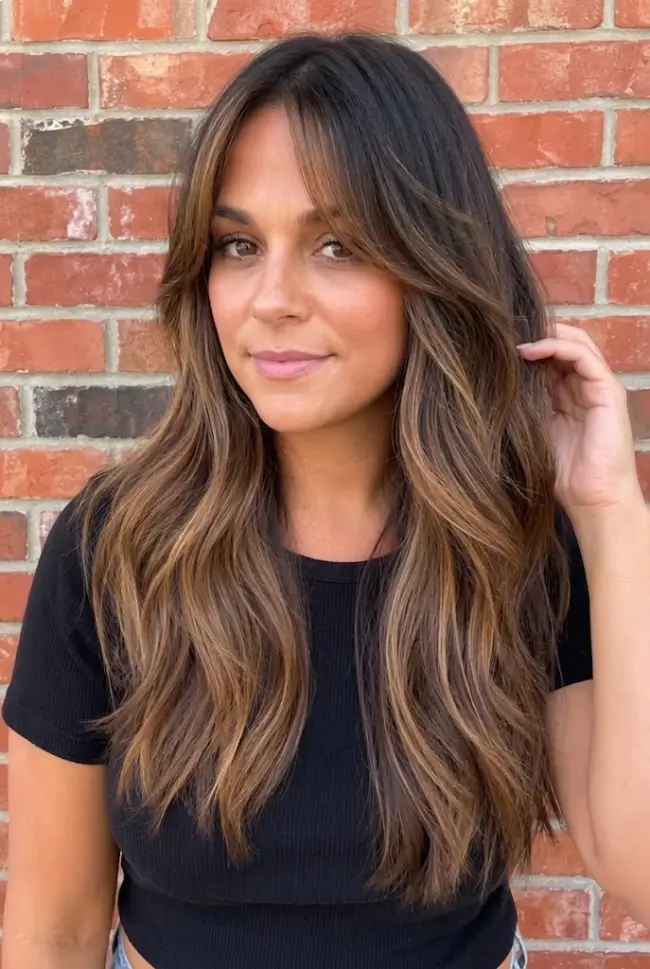
Caramel balayage works particularly well with long layers because the color can follow the movement of the haircut instead of appearing as one flat block. Lighter ribbons around the face can emphasize the curtain bangs and connect visually with longer face-framing layers.
The technique can suit medium-to-dark brunette bases when the desired contrast is carefully controlled. Fine hair can benefit visually from strategically placed dimension, although color alone should not be relied upon to create actual density. Thick hair provides plenty of surface area for balayage placement, while naturally wavy hair can make the color shifts especially visible.
One advantage of a softer balayage design is that the regrowth line can be less obvious than with a uniformly lightened root. Still, maintaining the tone may involve glossing or color-refreshing appointments. Home care should focus on keeping the lengths conditioned, particularly if lightening has been involved.
When discussing the cut and color, ask for long blended layers, soft curtain bangs, and caramel pieces that start subtly around the face before diffusing through the lengths. This creates a cohesive result rather than a strong stripe of brightness around the fringe.
14. Long Layered Hair With Bottleneck Bangs
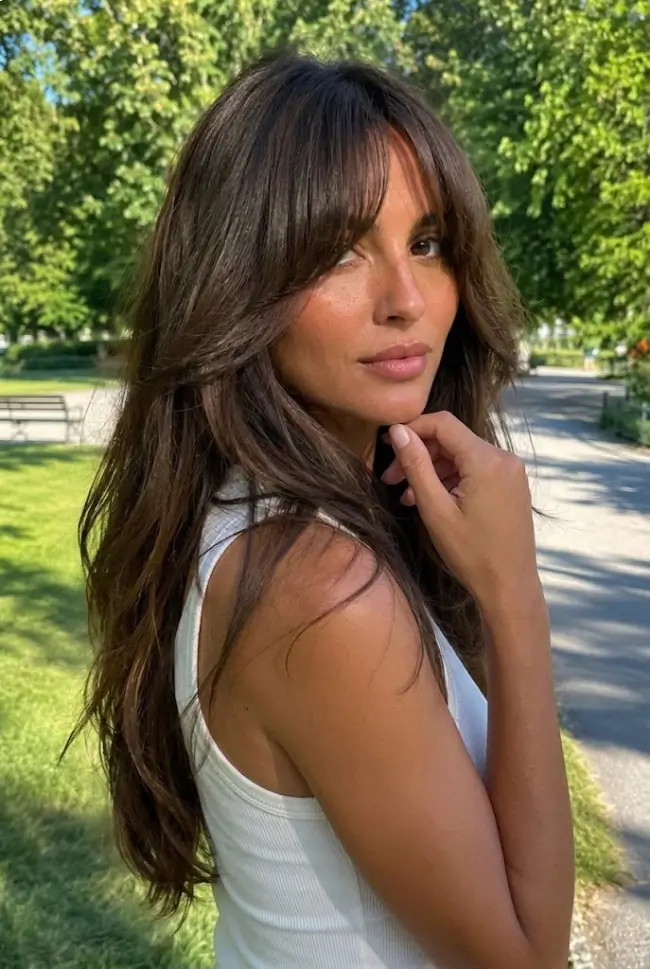
Bottleneck bangs sit between traditional curtain bangs and a fuller fringe. They tend to be narrower and shorter through the center, then gradually widen and lengthen toward the sides, creating a tapered shape that flows into face-framing layers.
This variation can be useful when you like the framing effect of curtain bangs but want slightly more definition through the center of the forehead. Fine-to-medium hair can work particularly well because the fringe does not need to be extremely dense. Thick hair may require careful weight control so the center does not become too bulky. Straight hair makes the shape obvious, while waves can soften it.
Styling is usually more involved than simply parting long curtain bangs. The center and sides may need a round brush or blow-dry brush to establish the intended direction. If you frequently wear your hair pulled back, remember that the shorter center section will remain loose.
Ask for a tapered bottleneck fringe with a lighter center and longer outer edges that connect directly into the long face-framing layers. This is a useful choice for someone who wants a more defined fringe without committing to a traditional full bang.
15. Long Hair With Wispy Curtain Bangs
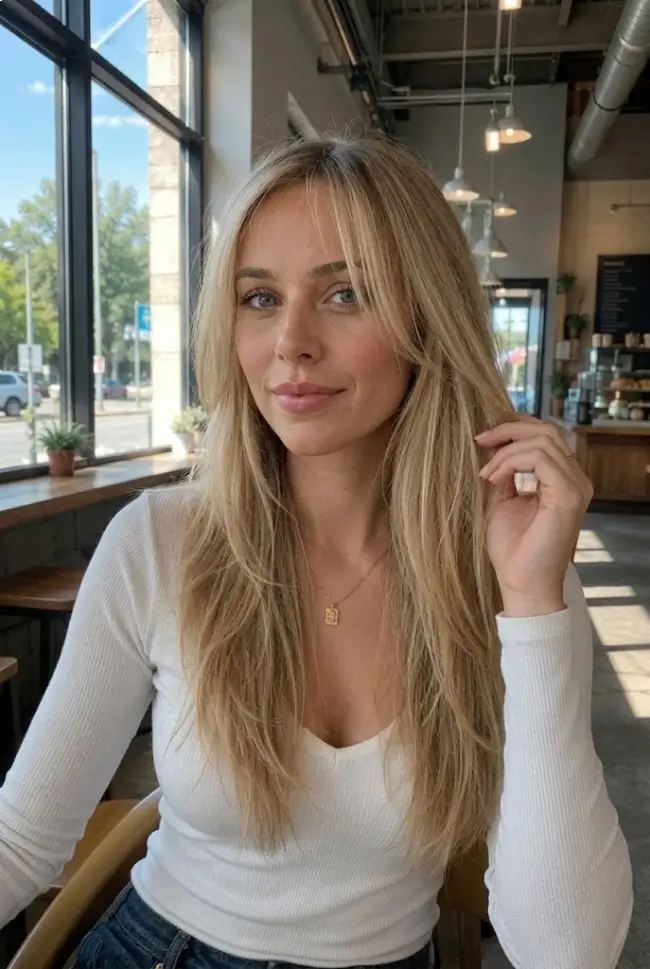
Wispy curtain bangs are intentionally lighter and more separated than a full curtain fringe. They are a useful option when you want some face framing but are hesitant to remove a large amount of hair from the front.
Fine hair can be particularly well suited to this approach because a heavy bang can make the fringe look sparse rather than intentionally delicate. Medium-density hair can also wear wispy bangs, although the stylist may need to select only a small amount of hair for the fringe. Thick hair can require controlled removal to prevent the wispy section from looking disconnected from the rest of the haircut.
The biggest advantage is commitment. Because less hair is taken into the fringe, the grow-out can be easier than with a dense bang. The limitation is that wispy pieces may separate or move more readily throughout the day, particularly in humidity or wind.
A lightweight styling cream or small round brush can help direct the front sections. Ask for light, airy curtain bangs with longer side pieces and enough separation that the fringe remains soft rather than becoming a solid block. This is one of the more approachable versions for someone trying curtain bangs for the first time.
16. Long Layered Hair With Side-Parted Curtain Bangs
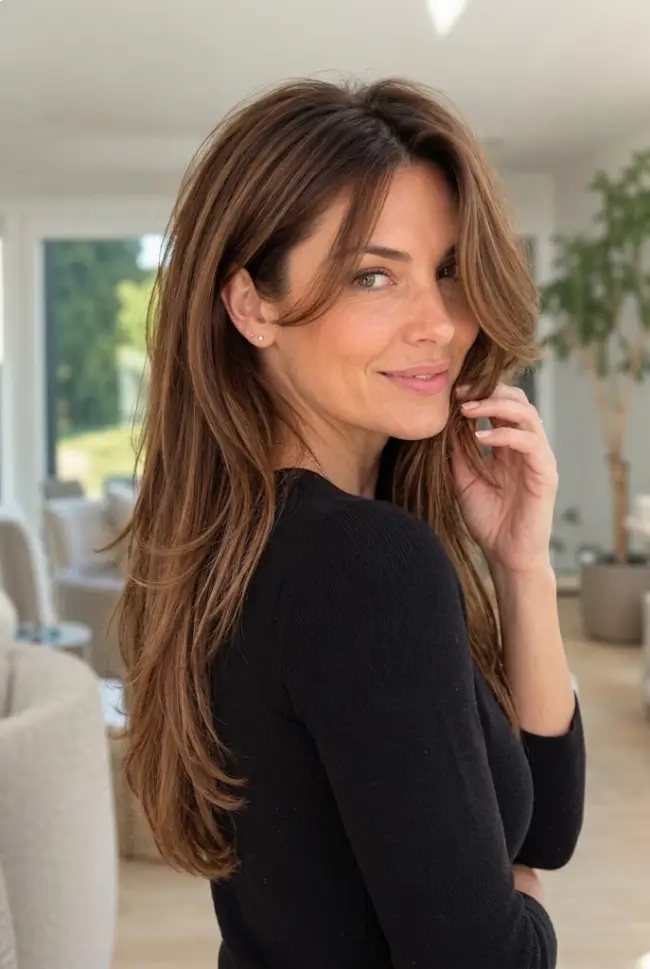
Curtain bangs do not have to be worn from a perfectly centered part. A side-parted version shifts the visual balance, allowing one side of the fringe to become longer and more prominent while the opposite side blends more quickly into the surrounding layers.
This is particularly useful for someone who naturally parts their hair to one side and finds a center part uncomfortable or unnatural. Straight hair will show the asymmetry clearly, while waves can make the transition softer. Thick hair may need additional weight control around the heavier side, and fine hair can benefit from maintaining enough density so the larger section does not appear too thin.
The style requires some directional training. A blow-dry brush or round brush can help establish the part and guide the fringe toward the cheekbone. Humidity may cause the front to shift, so a flexible-hold product can help without making the hair stiff.
Tell your stylist you normally wear a deep or moderate side part and want the curtain fringe designed around that part rather than cut for a center part. This distinction matters because the same bang length can behave very differently when the part changes.
17. Long Layered Ash Brunette With Curtain Bangs
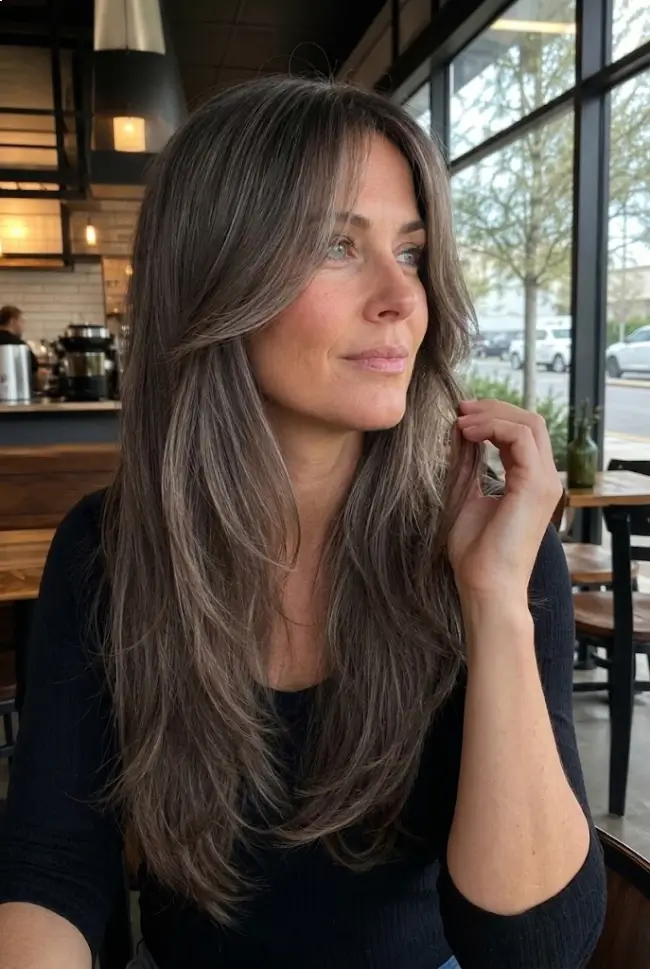
Ash brunette combines the long layered silhouette with a cooler brown color direction. The haircut itself can range from subtle long layers to more pronounced face framing, while the ash tone changes the overall mood without requiring an especially dramatic cut.
This color is most useful when the desired result is a cooler, less golden brunette appearance. However, hair color should be selected according to the starting shade, previous color history, and the result you can realistically maintain. Long hair also means that color-treated ends may require more conditioning than untreated roots.
The layered haircut works across several textures. Straight hair makes the cool color and layered outline especially clear, while waves add dimension as the different sections catch light. Fine hair can benefit from restrained layering so the ends retain fullness. Thick hair can support more visible movement.
Maintenance may include occasional color refreshing or toning depending on how the shade changes over time. Ask your stylist for a cool brunette tone without excessive grayness, paired with long blended layers and curtain bangs that frame the face without becoming too heavy. A conditioning routine is especially useful when the lengths have been lightened to reach the desired tone.
18. Long Bohemian Layers With Curtain Bangs
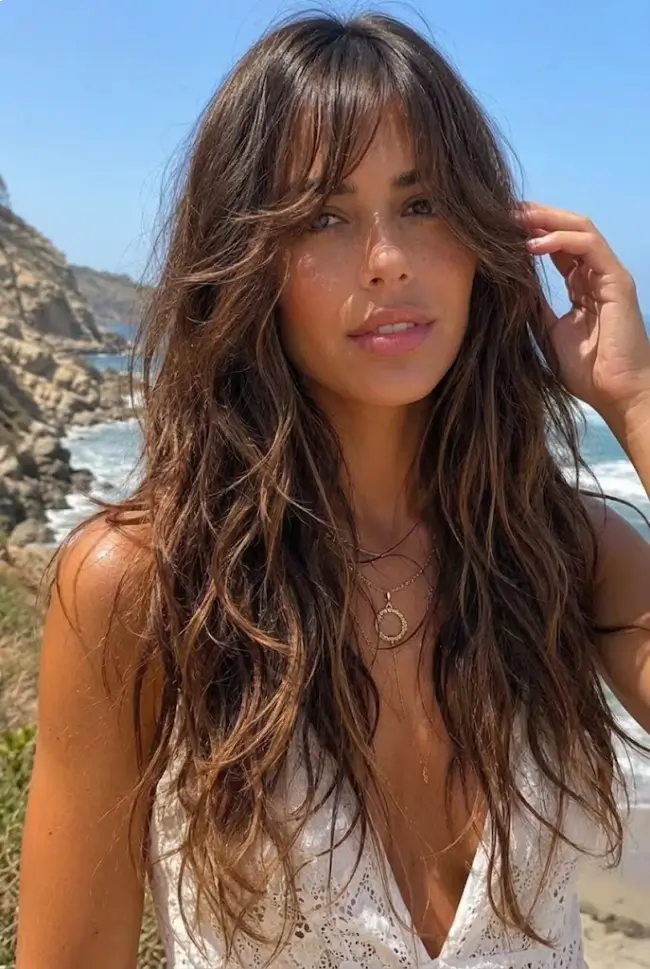
Bohemian layers are less about precise geometry and more about creating relaxed movement through long hair. The layering can be irregular enough to prevent the haircut from looking overly polished, while curtain bangs bring a controlled framing element around the face.
This style works especially well with naturally wavy or slightly textured hair because movement helps the layers look intentional without requiring every section to be heat-styled. Straight hair can wear it too, but texture spray, loose waves, or a rough air-dry technique may be needed to reveal the separation. Thick hair can support abundant layering, while fine hair should retain enough perimeter weight to prevent the lengths from looking overly wispy.
The appeal is its forgiving finish. A slightly imperfect air-dry can actually suit the aesthetic, making daily styling easier than with a heavily structured feathered or butterfly cut. The tradeoff is that the shape may look less defined if you prefer sleek, polished hair.
Ask for long, relaxed layers with movement beginning around the face, soft curtain bangs, and enough weight left through the ends to keep the hair looking substantial. It is a strong option for someone who wants long hair with personality but does not want to spend every morning creating a precise blowout.
How to Choose the Right Long Layered Haircut With Curtain Bangs
The most important decision is not the name of the haircut. It is where the shortest layer begins, how much weight is removed, and how the curtain bangs connect to the rest of the hair.
Start with your desired length. If preserving maximum length is your priority, classic long layers or invisible layers make more sense than a shag or wolf cut. If face framing is the main goal, a butterfly cut gives you much more visible movement around the cheeks and jaw.
Then consider density. Thick hair can generally tolerate more layering and weight removal, while fine hair often benefits from fewer, strategically placed layers. Texture matters just as much. Waves and curls naturally create movement, while very straight hair may need styling to reveal heavily layered shapes.
Your lifestyle should be part of the decision too. A butterfly or feathered cut can look beautiful when blow-dried but may require more effort than invisible layers. A shag or bohemian cut may be more forgiving if you prefer air-drying.
Finally, decide how much fringe commitment you actually want. Full curtain bangs make a stronger visual statement. Wispy curtain bangs offer an easier introduction, while bottleneck bangs sit somewhere between the two.
Long Layers by Hair Type
Fine Hair
Fine hair usually benefits from strategic rather than excessive layering. Removing too much hair from the lower lengths can make already-delicate ends look thinner, particularly when the haircut is very long. Invisible layers, classic long layers, and restrained face framing are often easier to balance than a heavily layered shag or wolf cut.
Curtain bangs can still work beautifully. A wispy version may be particularly practical because it gives the face framing without taking a large section of hair away from the main body. If you want a butterfly cut, ask your stylist to preserve enough density through the perimeter and avoid creating too many disconnected short sections.
Styling products should generally be lightweight. A volumizing mousse at the roots or a light texture spray may add body without weighing the lengths down. Heat styling can create more visible layers, but frequent high heat can make fine hair feel dry or brittle, so heat protectant and moderate temperatures are sensible.
Thick Hair
Thick hair gives you more freedom with layered shapes, but the goal should be controlled weight removal rather than simply adding layers everywhere. Too much internal removal can create unwanted bulk in some areas while making the ends look disconnected.
Long shags, wolf cuts, butterfly cuts, V-cuts, and feathered layers can all take advantage of substantial density. A classic long layer is better when you want to keep the silhouette relatively polished. Curtain bangs may also need weight removed strategically so they do not become overly dense at the center.
For thick, straight hair, a blow-dry can reveal the structure. Thick wavy hair may need only a curl cream or texture product. If you regularly tie your hair back, discuss the placement of layers because very short front pieces can escape a ponytail.
Tell your stylist exactly where your hair feels heavy. That gives them more useful information than simply asking for “lots of layers.”
Straight Hair
Straight hair makes the architecture of a haircut easy to see. Clean V-shapes, feathered layers, invisible layering, and face-framing sections can all look distinctly different because there is less natural texture obscuring the cut.
The tradeoff is that straight hair may require styling to reproduce the movement shown in many inspiration photographs. A butterfly cut photographed after a round-brush blowout may look much flatter when air-dried. Likewise, 70s feathering usually needs directional styling to create its characteristic sweep.
For a lower-maintenance result, consider invisible or classic long layers with curtain bangs that can simply be tucked behind the ears or softly directed outward. If you want visible texture without a daily blowout, a subtle wave or lightweight texture spray can help.
When showing your stylist a reference photo, mention whether you plan to style your hair. That prevents a mismatch between the haircut’s designed finish and your actual routine.
Wavy Hair
Wavy hair naturally supplies movement, which makes it an excellent foundation for many long layered cuts. Beachy waves, long shags, bohemian layers, and softer butterfly shapes can work especially well because the natural bend reveals separation between layers.
The main concern is uneven behavior. Some sections may wave strongly while others remain relatively straight, particularly around the front. Curtain bangs should therefore be cut with the natural texture in mind. A bang that looks perfectly symmetrical when wet or stretched may sit differently once dry.
Use lightweight curl or wave products rather than heavy smoothing formulas if you want the texture to remain visible. Air-drying can work well for shaggy and bohemian cuts, while a diffuser can help if your waves need encouragement.
For a polished appearance, a round-brush blowout or loose curling technique can temporarily smooth and reshape the texture. Decide whether you want to work with your natural waves or regularly style them before choosing a highly structured cut.
Curly Hair
Curly hair needs a different approach to layering because curl spring can significantly change the apparent length. A long curly haircut should be planned around the dry shape, density, curl pattern, and desired volume.
Long curly layers are the most obvious choice from the 18 variations, but a softer butterfly-inspired shape can also work when adapted to the curls. Curtain bangs should generally be long enough to accommodate shrinkage. Cutting them according to stretched length without considering the dry result can leave them much shorter than expected.
Curl cream and gel can help create consistent definition. A diffuser can speed drying while preserving shape, although air-drying may be preferable if that fits your routine.
Face framing should follow the natural curl pattern rather than forcing every curl into an identical line. Ask your stylist how the haircut will behave when completely dry, and make sure the consultation includes your normal styling method. That information is often more useful than discussing length alone.
Coily Hair
For long coily hair, the haircut should respect the natural coil pattern and the degree of shrinkage. A curtain-bang effect can be created through longer front and crown sections that open from a center part and sweep outward, rather than requiring a conventional straight fringe.
Layering should be intentional. Too little shaping can leave the hair visually heavy, while too much removal can create an uneven perimeter once the coils contract. Discuss the desired dry shape and whether you normally wear your hair natural, stretched, braided, or in another style.
Moisture and definition are usually more relevant than heat styling. Curl-defining products can help the front sections maintain their shape, while satin protection at night can help preserve the styling pattern.
If you frequently exercise, wear protective styles, or need to pull your hair away from the face for work, mention this during the consultation. The haircut should fit the way you actually wear your hair, not just the appearance of a single inspiration photo.
Long Layered Haircuts by Face Shape
Round Face
With a round face, the goal does not have to be making the face look “less round.” Instead, consider how the haircut distributes visual weight. Longer curtain bangs that open below the cheekbones can create vertical movement, while face-framing layers can draw the eye downward.
A butterfly cut can work if the shortest layers are placed thoughtfully rather than ending at the widest part of the cheeks. Long invisible layers are another understated option. Very full volume directly beside the cheeks may emphasize width, so you may prefer movement that begins slightly lower.
Waves can soften the outline, while a straighter finish can make the layering more graphic. The best choice depends on whether you want softness, definition, or volume.
Oval Face
An oval face offers considerable flexibility because many long-layered silhouettes can be adjusted without needing to compensate for a particularly broad or narrow area. Classic long layers, butterfly layers, feathered styles, wispy curtain bangs, and side-parted versions can all be adapted.
The more important question is which facial features you want the haircut to emphasize. Shorter curtain pieces can highlight the cheekbones, while longer pieces can create a more understated frame around the jaw.
Because the overall proportions are already relatively balanced, avoid choosing a haircut solely because it is labeled “best for oval faces.” Instead, decide whether you want maximum movement, subtle layering, a dramatic fringe, or easy grow-out.
Square Face
A square face often has noticeable angles through the forehead, cheeks, and jaw. Long layers with curved or sweeping movement can introduce softness without hiding those natural features.
Curtain bangs are particularly adaptable because they can be cut longer toward the sides and directed outward. Feathered layers and soft waves can further reduce the appearance of hard transitions in the hairstyle. A very geometric V-cut or sharply razored finish will create a different, more structured effect if that is what you prefer.
The key is placement. Ask your stylist where the first face-framing layer will fall when your hair is dry. A few inches of difference can change whether the framing sits around the cheekbones, jaw, or below the shoulders.
Heart-Shaped Face
A heart-shaped face often has more visual width around the forehead with a narrower lower face. Curtain bangs can balance the upper area when they are kept soft and blended rather than extremely dense.
Longer side pieces can guide the eye toward the cheekbones and jaw, while layers below the chin can add movement through the lower half of the hairstyle. Butterfly layers can work, but the shortest sections should be chosen according to the face rather than copied exactly from a reference photo.
A side-parted curtain fringe can also create an appealing asymmetrical effect. Fine hair may benefit from a lighter fringe, while thicker hair can support more substantial framing.
Long Face
With a longer face shape, the placement of volume becomes especially important. Very long, flat hair with minimal movement can emphasize vertical length, while layers and waves can introduce width.
Curtain bangs can be useful when they sit across the upper or middle face rather than extending too far downward. A fuller bottleneck or softly feathered fringe can create more horizontal interest. Long layers should ideally include some movement around the sides rather than concentrating all volume at the bottom.
If your hair is naturally straight and fine, consider whether you are willing to style the layers. A cut designed to have substantial movement may look much flatter without blow-drying or another styling technique.
Diamond Face
Diamond-shaped faces often have noticeable cheekbone width with a comparatively narrower forehead and jaw. Curtain bangs can be customized to soften the transition around the forehead, while face-framing layers can emphasize or soften the cheekbone area depending on their placement.
Wispy curtain bangs provide a lighter approach, while bottleneck bangs create more visible structure. Long layers below the jaw can add movement toward the lower part of the face.
The goal is not to follow a rigid “diamond face haircut rule.” Look at the entire silhouette. If your hair is thick, you may want controlled movement rather than excess width at the cheekbones. If your hair is fine, subtle layers may create enough shape without sacrificing too much density.
Which Long Layered Haircuts Are Lowest Maintenance?
If you want to minimize daily styling, the best candidates are generally classic long layers, invisible layers, bohemian layers, and softer beachy or naturally wavy versions.
The reason is simple: these shapes do not depend as heavily on precise blow-drying to look intentional.
A butterfly cut can be moderate maintenance because the shorter layers look most defined when lifted. Feathered layers are more styling-dependent because the ends need directional movement. A shag or wolf cut can actually be easy for naturally wavy hair but more demanding for very straight hair.
Curtain bangs themselves are usually the part that requires the most frequent attention. They sit near the face, so small changes in direction are visible. If you want the look with less commitment, wispy curtain bangs provide an easier starting point.
Can You Tie Long Layered Hair With Curtain Bangs Back?
Yes. Because the overall length remains long, most of these styles can still be gathered into a ponytail or bun. The limitation is the layering around the face.
Classic long layers and invisible layers usually provide the easiest transition into a ponytail because the shortest pieces remain relatively long. Butterfly cuts, shags, and wolf cuts can leave more pieces around the cheeks and crown. Those sections may fall out during workouts.
Curly and coily hair can also require different approaches because shrinkage affects the apparent length. A style that looks long when stretched may not gather as easily in its natural state.
If tying your hair back is important, tell your stylist. Ask them to preserve enough length around the crown and sides for your usual ponytail while still creating the desired face framing. That single request can prevent an otherwise beautiful haircut from becoming frustrating during exercise or work.
Long Layers vs. Butterfly Cut vs. Long Shag
| Feature | Classic Long Layers | Butterfly Cut | Long Shag |
| Overall feel | Polished and versatile | Voluminous and layered | Textured and relaxed |
| Layer visibility | Subtle to moderate | High | High |
| Face framing | Moderate | Strong | Strong |
| Fine hair | Good with restraint | Needs careful layering | Can look wispy if over-layered |
| Thick hair | Very adaptable | Excellent | Excellent |
| Wavy hair | Easy match | Strong match | Excellent match |
| Straight hair | Low to moderate styling | Moderate styling | More styling may be needed |
| Air-drying | Usually easy | Less predictable | Good for natural texture |
| Grow-out | Forgiving | Moderate | Moderate |
| Ponytail practicality | Excellent | Good | Good, with more loose pieces |
| Best for | Versatility | Dramatic movement | Texture and personality |
If you want a haircut that will still look good on rushed mornings, classic or invisible layers are the safest choices. If the haircut itself is supposed to be the statement, butterfly or shag layers make more sense.
How to Style Long Layered Hair With Curtain Bangs
Start with damp hair and apply a lightweight product suited to your texture. Straight hair can benefit from a smoothing or volumizing product, while wavy and curly textures generally need products that support their natural pattern.
For a classic curtain-bang finish, divide the fringe at the natural part. Use a small or medium round brush to direct each side away from the face. The goal is movement rather than a rigid curl.
For butterfly and feathered layers, use a larger round brush or blow-dry brush on the shorter sections, lifting them away from the head. Once cool, gently brush through the hair so the sections blend.
For shaggy, wolf, beachy, and bohemian cuts, texture spray or a lightweight styling cream can be more appropriate. Scrunching and air-drying may reveal more of the intended movement than a perfectly smooth blowout.
For curly and coily hair, work with the natural pattern instead of brushing the finished curls dry. Apply styling products while the hair is wet, shape the curls, then air-dry or diffuse.
Heat protectant is worth using whenever a blow-dryer, iron, or other heated tool is involved.
What to Tell Your Stylist
A useful salon consultation should describe length, layering, fringe placement, texture, and your styling routine rather than relying on a haircut name alone.
For a subtle result, say:
“I want to keep most of my length, with long blended layers and curtain bangs that gradually connect into the face-framing pieces.”
For a butterfly cut:
“I want pronounced face-framing layers around the cheekbones and jaw, but I want the back length preserved.”
For a shag:
“I want a long shag with noticeable crown movement, but I still want the overall length to remain long.”
For fine hair:
“Please keep enough weight through my ends so the perimeter doesn’t look thin. I want movement without excessive thinning.”
For thick hair:
“I want the bulk controlled internally, but I don’t want the ends to look overly wispy.”
For curls:
“Please cut according to my natural curl pattern and dry shrinkage, and make sure the curtain bangs land where I expect them when dry.”
Also discuss your natural part. A center-parted curtain fringe and a side-parted curtain fringe are not interchangeable, and the haircut should be designed around how you actually wear it.
Frequently Asked Questions
Are curtain bangs good with long layered hair?
Yes. Long layers provide movement through the body while curtain bangs create a visible frame around the face. The combination can be customized from subtle and low-maintenance to dramatic and heavily layered.
Are long curtain bangs easier to maintain than short bangs?
Generally, longer curtain bangs can be more forgiving during grow-out because they blend into the face-framing layers. However, they still require occasional shaping and may need styling to stay away from the face.
Which long layered haircut is best for fine hair?
Classic long layers, invisible layers, and wispy curtain bangs are generally easier to balance because they can create movement without removing too much density. Butterfly, shag, and wolf cuts can also work, but the layering needs to be more carefully controlled.
Can thick hair have curtain bangs?
Absolutely. Thick hair can support substantial curtain bangs, although the fringe may need internal weight management so it does not become overly heavy or difficult to direct.
Do curtain bangs work with curly hair?
They can. The key is cutting them according to the natural curl pattern and expected shrinkage. A stylist should consider where the curls sit when dry rather than relying only on the stretched length.
Can I air-dry long layers with curtain bangs?
Many versions can be air-dried, especially invisible layers, bohemian layers, beachy waves, and long shags on naturally textured hair. More structured butterfly and feathered styles usually show their shape more clearly after some styling.
How often should long layered hair be trimmed?
The ideal schedule depends on the haircut, fringe, texture, and how precisely you want to preserve the shape. Curtain bangs generally need attention sooner than the long lengths because they are highly visible around the face.
Will long layers make my hair look thinner?
They can if too much weight is removed, particularly from fine hair. Ask for strategic layering and explain that maintaining fullness through the perimeter is important to you.
Can I put layered hair in a ponytail?
Usually, yes. The overall length makes ponytails possible, but shorter face-framing pieces and crown layers may fall out. If you exercise or frequently tie your hair back, tell your stylist before the cut.
Should curtain bangs be cut in the center or around my natural part?
Usually, the haircut should reflect how you actually part your hair. If you consistently wear a side part, tell your stylist so the fringe can be shaped accordingly.
Is a butterfly cut or classic long layers easier to maintain?
Classic long layers are generally easier because the shape is less dependent on styling. Butterfly cuts have more visible short layers, so blow-drying or another styling method may be needed to reveal the intended separation.
What should I bring to a haircut consultation?
Bring a few reference photos showing the front, side, and overall length you like. Also explain your natural texture, density, normal part, styling habits, and whether you regularly wear your hair up. A photo of the desired result is useful, but your routine determines whether the cut will be practical for you.